Questions?
We reply within 24 hours, free of charge.
On 19 October 2026, Thailand's Prime Minister, who also holds the Interior Minister portfolio, ordered the Department of Lands and provincial governors to finish investigating high-risk cases of nominee land holding by December 2026, to pursue compulsory sale of land held unlawfully, and to vet the buyers of that land, as Thai and English-language press report the announcement. No new law or regulation came with the announcement: the measures rest on the existing Land Code and the Foreign Business Act. The December deadline is for finishing investigations, not for court cases or sales.
In short
- On 19 October 2026, the government ordered investigations into high-risk nominee landholdings to be completed by December 2026.
- No new law was passed. The rules in force are the same Land Code and Foreign Business Act provisions that already applied.
- The deadline is for the investigation stage. Forced sales and prosecutions, where they happen, follow afterward under the existing procedure.
- Buying a condo within the 49% quota or a villa on a registered lease stays lawful and is not the target of this drive.
What was announced on 19 October
The order covers two things, as Thai and English-language press reported the announcement. First, the Department of Lands and provincial governors are to finish checking high-risk nominee cases by December 2026. Second, officials are to pursue compulsory sale of land found to be held unlawfully and to screen the buyers in any resulting sale.
The Department of Lands gave preliminary figures at the launch: about 1,397 suspected holders, 2,360 plots, roughly 5,467 rai, and about THB 14 billion in land value, with 13,088 entities named in the wider risk group. These are suspicions flagged for investigation, not confirmed violations, and they are separate from earlier figures reported for Koh Samui, the Andaman raids in June, and the September nationwide screening.
Is this a new law, and what rules actually apply
No new statute or ministerial order came with the 19 October announcement. The legal basis is unchanged: Land Code section 94 lets officials require a holder of land held without lawful right to dispose of it within a period of 180 days to one year, as Thai lawyers and the Department of Lands describe the provision. If the holder does not sell in time, the state sells the land and pays the proceeds to the holder, not to the state itself. Penalties under the Land Code reach up to two years' imprisonment and/or a fine of up to THB 20,000 for both the foreign principal and the Thai nominee, as the Department of Lands cites them, and the Foreign Business Act carries a separate penalty of up to three years and a fine of up to THB 1 million.
Separately, a regulation of the Prime Minister's Office has been in force since 28 August 2026 that lets the Interior Minister deport a foreigner whose conduct threatens public order, or after a served sentence for certain offences, including running a business in breach of the foreign-business law. Deportation is not automatic for nominee buyers, and nothing in the 19 October order says otherwise. The Department of Lands screening thresholds that have applied since May 2026 — reviewing the source of funds behind cash purchases of THB 2 million or more, or appraised values of THB 5 million or more — have not changed.
Who this affects, and Phuket specifically
The drive targets structures where a foreigner funds or controls a Thai-shareholder company that holds land, typically a villa or a plot registered to a company with Thai nominee shareholders. Phuket is one of the provinces the Department of Lands has flagged as a priority: Department of Lands figures of 10 July 2026 counted 317 companies and 486 plots in the province.
What is not targeted: a condominium unit bought within the 49% foreign ownership quota, a lease properly registered at the Land Office for up to 30 years, a registered usufruct or superficies, and companies operating under BOI promotion or a Foreign Business Licence. For US nationals, a Treaty of Amity certificate is a route to run a business in Thailand, but no treaty, including this one, gives a foreigner the right to own land in Thailand.
If your villa is held through a Thai company and you are not sure how the shareholding and the funding were structured, we suggest acting now rather than waiting for a letter from an agency.
- Pull the company's own paperwork first. Start by gathering the shareholder register, the share certificates, and the bank records showing where the money for each Thai shareholder's shares actually came from.
- Check whose name the land is registered under and where the purchase money came from. This is exactly what Land Office source-of-funds checks look at.
- Talk to a lawyer about a lawful structure before you do anything else. We do not advise moving the land to another Thai name or another company: that is the same arrangement the current checks are built to find, not a fix for it.
If your villa is registered to a Thai company, send us the company documents and the purchase agreements. Our lawyers will look at how the structure is set up and explain the lawful options. We answer within 24 hours, and we agree the cost of the work before we start. We do not promise an outcome with a government agency, and no lawyer honestly can.
What we don't know yet
We have not seen the government's own written text of the 19 October order, so we rely on press reporting of the announcement rather than the instruction itself. There is no public breakdown of how the national figures apply specifically to Phuket. And nothing has been said about an amnesty, a voluntary-disclosure window, or any grace period for restructuring before enforcement — none of these exist today, and we will say so plainly if that changes.
If you own property through a Thai company structure, our team can review the documents and walk you through where you stand under the rules as they exist now, before you decide on any next step. See registered leasehold versus freehold ownership in Thailand, a villa held through a nominee company and the DBD checks, and the typical situation of a nominee company villa restructured before a DBD check. If you are still deciding how to buy, buying land in Phuket as a foreigner sets out the lawful routes.
Phuket areas
The same laws apply across the island, but each area has its own particulars: what kind of property usually sells there, which documents prove rights to the land and what deserves a closer look before you buy.
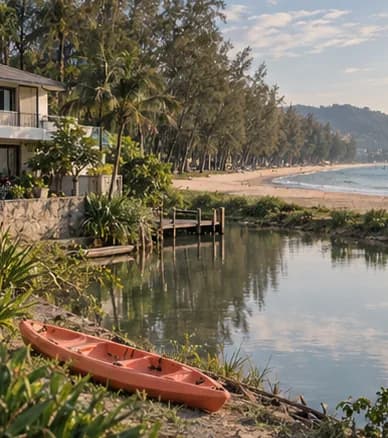
Bang Tao
There are many villas here, including in the Laguna complex, and most are bought on a leasehold, so our lawyers look first at the renewal terms in the contract.

Rawai
Many villas here are held through Thai companies, so we check whether the structure is lawful.

Chalong
Land here is held under different documents, from a Nor Sor 3, which gives only a right of possession, to a chanote, which confirms full ownership. That is why we start by checking which document has been issued for the plot.
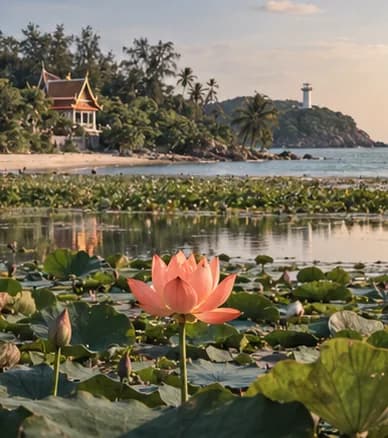
Nai Harn
Many villas here are in quiet spots, so before buying it is worth finding out how you get to the plot. If the road crosses a neighbour's land, we check whether a servitude, a registered right of way, is in place.