Questions?
We reply within 24 hours, free of charge.

A Phuket second home and a Phuket rental investment are bought through the same two legal routes: freehold ownership of a unit inside a condominium's 49% foreign quota, or a registered leasehold. What changes with the purpose is not the ownership form but which unit fits it, how you may let it, and which taxes apply. Letting a unit for under 30 days without a hotel licence is illegal (Hotel Act B.E. 2547), so a unit bought for income is best chosen with a monthly-rental plan already in mind, or inside a building that already holds that licence.
In short
- The purchase route — freehold within the 49% quota, or a registered leasehold — is the same for a second home and a rental unit; the goal changes the checklist, not the paperwork.
- Letting a unit for less than 30 days needs a hotel licence under the Hotel Act B.E. 2547; a monthly or longer lease does not.
- Rental income sits on Thailand's progressive personal income tax scale, with a 30% flat deduction or actual expenses to choose from.
- Selling within five years of buying brings Specific Business Tax of 3.3%, unless the owner was registered in the house book for a year or more, in which case stamp duty of 0.5% applies instead.
- For a Thai-majority company buying land, the Thai shareholding must be genuine and funded by the Thai shareholders; a foreign-majority company generally cannot buy land unless it qualifies under a specific statutory exception, and can instead buy a condo unit within the 49% quota. Either way, a company set up just to put Thai names on paper is an illegal nominee structure.
Living in it vs earning from it: the legal difference
Whether you plan to live in a unit yourself or rent it out, Thai law offers the same two main routes: buy a condominium unit as freehold property within the building's 49% foreign-ownership quota (Condominium Act B.E. 2522, section 19), or buy a villa, townhouse or other land-based property on a registered leasehold — the standard way foreigners buy houses in Phuket. Neither route belongs to one purpose more than the other.
What the purpose changes is everything downstream of the signature: how you may let the unit, what tax the rental income brings, and how an early resale is taxed.
| A home for yourself | A unit for rental income | |
|---|---|---|
| Ownership form | Freehold within the 49% quota, or leasehold | Same |
| Letting | Occasional stays by family or friends | Monthly or longer tenants without a licence; under 30 days needs a hotel licence |
| Income tax | None | Progressive personal income tax on the rent received |
| Sale within 5 years | Stamp duty 0.5% if registered in the house book a year or more, otherwise Specific Business Tax 3.3% | Specific Business Tax 3.3% is the likely outcome, since the unit is not your registered home |
| What we check | Quota share, funds-transfer proof, leasehold renewal terms | The same, plus the building's letting rules, any hotel licence claimed, and the sublet clause in the contract |
We treat the ownership question as something to settle once, at the start. The letting and tax questions below depend on what you plan to do with the keys, so we look at those unit by unit.
Short lets vs long lets: what is allowed
Thailand treats paid accommodation for under 30 days as a hotel business. Under the Hotel Act B.E. 2547, anyone offering it — including a condo owner listing on Airbnb, Booking.com or Agoda — needs a hotel licence. Without one, the Hotel Act carries up to one year in prison and/or a fine of up to THB 20,000, plus up to THB 10,000 for every day the violation continues. Thai law firms report that the Condominium Act adds its own fine, up to THB 50,000 plus THB 5,000 a day, for running a business inside a residential unit, and a building's own house rules usually add further fines on top.
A lease for a month or longer sits outside the Hotel Act. That is the practical reason a rental-focused purchase is easier to plan around monthly tenants than around nightly bookings, unless the building itself already holds a hotel licence.
Whatever the length of stay, the owner or manager must report a foreign guest to the Immigration Bureau within 24 hours (the TM30 notification).
For the fuller set of rules on renting out a Phuket unit, including TM30 and house rules, see renting out legally in Phuket.
Rental income tax for a foreign owner
Rental income is assessable income under the Revenue Code and falls on Thailand's progressive personal income tax scale: the first THB 150,000 of net income is exempt, then rates run from 5% up through 35% on the highest band. From the gross rent, an owner deducts either a flat 30% without receipts or the actual expenses incurred, whichever fits the numbers better.
Thai-source rental income is taxable in Thailand on the same progressive scale whether or not the owner is a Thai tax resident. How withholding applies to a nonresident owner's remittances of that income depends on the lease and the payment arrangement, so our team checks it against your paperwork before putting a number on it.
A second tax sits in the background rather than on the yearly return: Land and Building Tax. The rate actually applied to residential property currently runs 0.02–0.10% of the appraised value, well under the statutory ceiling. A Thai individual's main home can claim an exemption on the first THB 50 million of appraised value, and a second home registered in the house book an exemption on the first THB 10 million. Whether a foreign owner can be entered in the house book at all — which that second exemption depends on — is a separate question, and we look at it case by case rather than assume an answer either way.
Freehold, leasehold or a company: which fits the goal
Freehold ownership inside a condominium's 49% quota is the most direct route for a rental unit, provided the quota still has room when you register and the purchase money is sent from abroad and converted to baht through a Thai bank, with the bank's confirmation ready for the Land Department (Condominium Act, section 19). The quota can move between the day you first check it and the day you register, so we check it again right before transfer.
For a villa, townhouse or any land-based property, buying on a leasehold is the ordinary route: a lease of the land registered at the Land Department for one term of up to 30 years (Civil and Commercial Code, section 540). Extending beyond that term takes a new agreement once the first one runs out, and nothing guarantees one in advance — our lawyers look at how the current contract handles renewal before you sign. For a rental purpose, the question that matters just as much is whether you may sublet the unit at all: by default a tenant may not sublet or transfer a lease without the lessor's consent, and doing so without it lets the lessor end the contract (CCC, section 544), so the lease itself needs to say subletting is allowed.
A foreign-majority company generally cannot buy land unless it qualifies under a specific statutory exception, such as permission to own land for a BOI-promoted activity; otherwise it can buy a condominium unit within the building's 49% quota if it meets the Condominium Act's conditions for a foreign juristic person (section 19). A Thai company buying land is a different question: eligibility to own the land requires its own check under the Land Code, and the Thai shareholding must be genuine and funded by the Thai shareholders. A company set up just to put Thai names on paper while a foreigner supplies the money and makes every decision is a nominee structure, and it is illegal under the Foreign Business Act whether the unit is rented out or not.
See freehold or leasehold in Thailand for how the two ownership forms compare, and a typical scenario — restructuring a villa held through a nominee company before a DBD check — for how that kind of exit usually works.
What to check in a rental property
- How much of the 49% quota is left, and whether the developer or juristic person will confirm it in writing.
- The condominium's own bylaws on letting: check them for restrictions on short stays and any approval you need before listing a unit.
- Whether the building genuinely holds a hotel licence, whenever a sales agent promises guaranteed nightly bookings.
- Any rental yield written into the sale contract: a promised figure does not guarantee the income will actually be paid, and we check what the clause commits the seller to and whether it can be enforced.
- For a leasehold villa, the sublet and transfer terms, and the land documents standing behind the lease.
- For a self-use purchase, whether you can register in the unit's house book, since that affects both the resale tax and the Land and Building Tax exemption later.
The buying costs that apply either way — transfer fee, the choice between stamp duty and Specific Business Tax, and Land and Building Tax — are set out in full in condo purchase taxes and fees in Thailand.
What to do next
Deciding between a home for yourself and a unit for rental income is easier before a deposit than after. Our team reviews the unit, the quota and the draft contract together, so the letting and tax questions are answered while you can still change the unit, not once you already own it.
For a condominium purchase from the first search to registration at the Land Department, see buying a condo in Phuket with legal support.
Our property and structure check — [price] — goes further than the free contract review: we confirm the quota and the funds-transfer requirements, read the condominium bylaws and the lease or company documents behind a villa, and tell you plainly what the unit in front of you will and will not let you do.
Phuket areas
The same laws apply across the island, but each area has its own particulars: what kind of property usually sells there, which documents prove rights to the land and what deserves a closer look before you buy.

Kata
In sea-view condominiums the 49% foreign quota usually runs out quickly, so we check it before you reserve a unit.

Patong
People buy condos here to rent out and open businesses that need licences.

Kamala
There are many branded residences here, homes sold under a hotel brand, and the management agreement needs careful reading before you buy.
Old Town
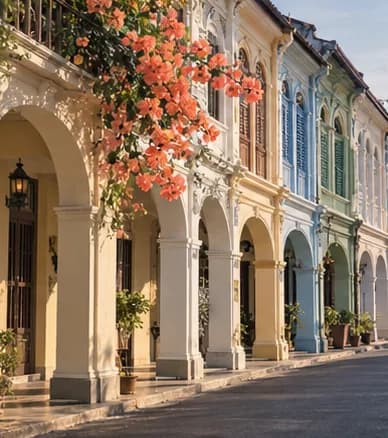
Many historic shophouses, buildings with a shop on the ground floor, are protected and can only be restored under special rules.