Questions?
We reply within 24 hours, free of charge.
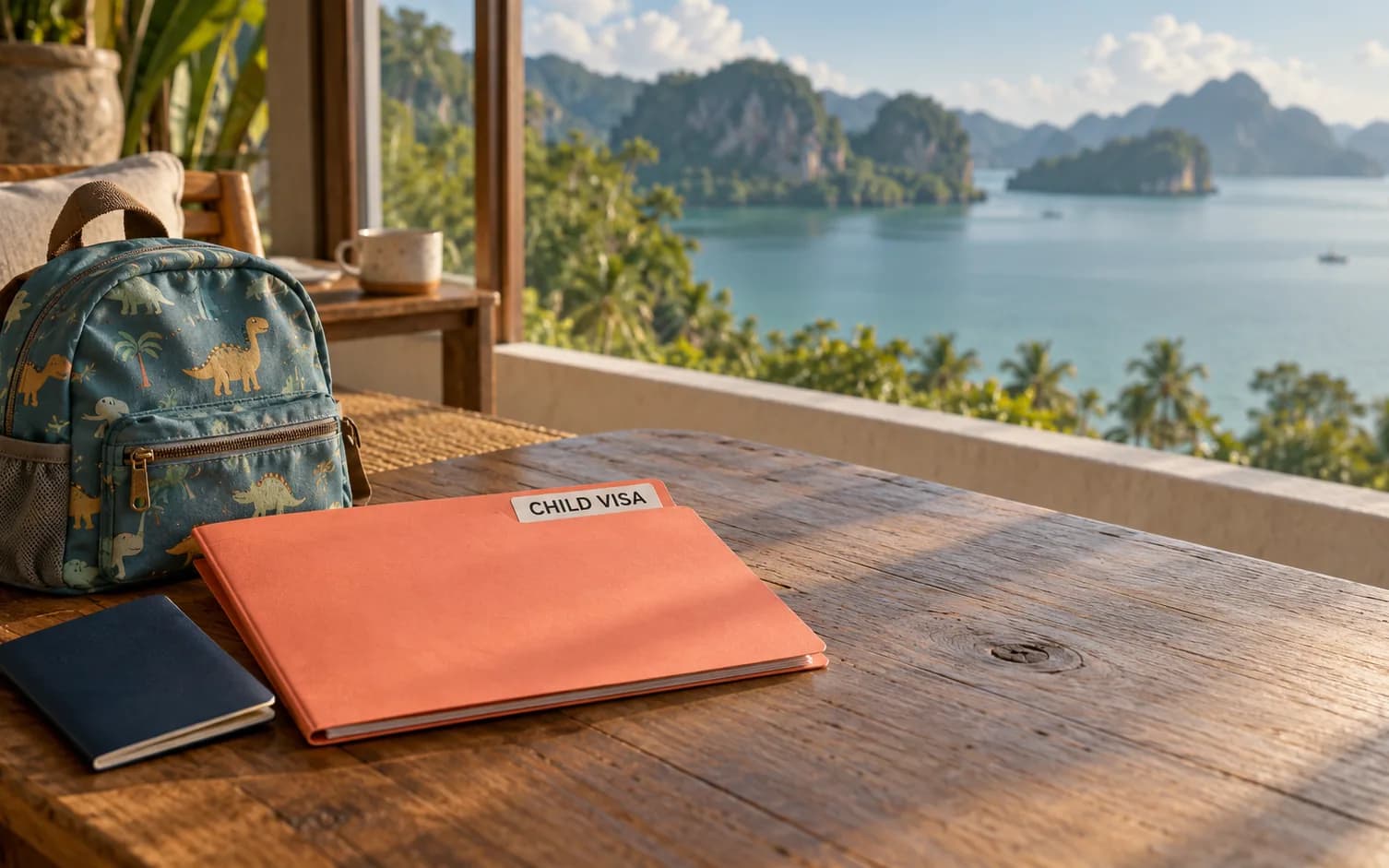
If your child is joining you in Thailand, they usually need a Non-Immigrant O visa as a dependant of the parent who already lives here. A Thai embassy issues it for a single entry, good for up to 90 days on first arrival. After that, a Thai immigration office extends the child's stay — up to a year at a time — and each extension is tied to the parent's own visa or extension. The path is clearest when the parent holds a work permit. When the parent is on a retirement visa, embassies take different positions, and some refuse outright.
In short
- A child joining a parent in Thailand usually needs a Non-Immigrant O visa, issued by embassy, then extended by immigration.
- "Child" generally means unmarried, living with the family, and not over 20 — adopted children and a spouse's children from an earlier relationship count too.
- Birth certificates usually need legalising, not just an apostille, at least until Thailand joins the Apostille Convention.
- If the parent is on a retirement visa, the child's visa is not guaranteed — several embassies refuse.
- We found no official rule on whether a child on a dependant Non-O needs a separate student (ED) visa to attend school.
Which visa a child joining a parent needs
The route has two stages. First, the child applies for a single-entry Non-Immigrant O at the Thai mission that handles family applications where you live — check with that mission which category and documents it wants. That visa gets the child into Thailand for up to 90 days on the first entry. Then, inside the country, an immigration office extends the stay, up to a year at a time, and every extension depends on the parent's own permission to stay: if the parent's basis for staying ends, the child's does too.
A "child" in this scheme is generally someone unmarried who lives with the family and is, as a rule, not over 20 — embassies word the age limit slightly differently, so check the notice from the mission you're applying to. Adopted children and a spouse's children from an earlier marriage are included in the same category.
A parent's status and what we know about the child's visa
| Parent's status | What's known about the child's visa |
|---|---|
| Work permit holder | The clearest case: embassies generally issue a Non-O to the child of a Non-B / work-permit holder, and immigration extends it alongside the parent |
| Retirement visa (Non-O, O-A or O-X) | Not guaranteed — several embassies refuse the family of a retirement-visa holder a dependant Non-O |
| Married to a Thai national (Non-O for the spouse) | The Thai government's family-extension guidance includes a spouse's children, but check the basis and process for the child's own visa with the embassy and immigration office |
| DTV (remote work / soft power) | A separate topic — see our guide to the DTV visa |
We'd suggest starting with the parent's own status: it decides the whole route, the documents, and which embassy to approach.
Documents: birth certificate, legalisation, funds
The usual document set for a child's visa looks like this:
- the child's birth certificate, or an adoption record;
- copies of the parent's passport and current visa or extension;
- for a working parent, also the work permit and a letter from the employer.
Translation and legalisation rules differ by mission, so confirm them with the embassy where you'll apply.
Every mission sets its own money requirement and consular fee for a child's visa, and there's no single figure across posts. Our lawyers check that every seal and signature is in order, and that names match across the family's documents, before anything goes to the embassy.
A child of a retirement-visa holder
We won't pretend there's a clear instruction here, because there isn't one single rule. The Royal Thai Embassy in Kuala Lumpur and the Royal Thai Consulate-General in Los Angeles both state directly that the family of a Non-O holder does not qualify for a dependant Non-Immigrant O. The Royal Thai Embassy in London's page on family visas names children only for applicants who work in Thailand — retirees aren't mentioned at all. An older set of extension criteria from 2020 did list a retirement basis among the statuses eligible for family extensions, but we haven't found the current, in-force wording of that provision published anywhere we could check.
The honest takeaway: before you book flights, ask the embassy where you're filing, and the immigration office where you'll extend the stay, whether a retiree's child qualifies today. We can help put those questions to the right office and get the paperwork ready while you wait for an answer.
A child of a work-permit holder
This is the most settled path. The child gets a Non-O as a dependant of a parent holding a Non-B visa and a work permit, and an employer's letter is usually part of the package. The extension then follows the parent's own extension.
The parent's own permission to stay has to be current for the child's family extension to go through, but renewing it doesn't by itself guarantee the child's extension is approved — the child's own application still needs filing. If the parent's permission to stay ends, the child's dependant basis is affected too. If the parent's job ends or the work permit changes, check the consequences for both permissions with the immigration office in advance.
Extending the child's stay and school
In Thailand, an immigration office extends a child's stay for up to a year at a time, and the usual extension fee is THB 1,900. Whether a birth certificate needs legalising and translating specifically for the first extension in Phuket isn't officially spelled out anywhere we found — we'd raise that question with the immigration office in advance, alongside the rest of the documents.
We haven't found an official rule, in either direction, on whether a child on a dependant Non-O needs a separate education (ED) visa to attend school in Thailand. Before you enrol your child, check directly with the school and with the immigration office.
Our team can prepare the child's extension package alongside the parent's own extension, so both applications move on the same timeline.
When only one parent is travelling with the child
Rules on a child travelling with just one parent vary by country, and we haven't researched every jurisdiction's own exit requirements — check your own country's rules before you book. On the Thai side, we found only one documented mission rule: the Royal Thai Consulate-General in Los Angeles asks for a notarised consent letter from the parent who isn't travelling when a child enters with only one parent. That's this mission's own requirement, not a general Thai rule, so confirm what the embassy you're filing with actually asks for.
What's still not clear
Several questions have no published answer yet: the current, in-force text of the extension provision covering family status for different visa types, including retirement; whether retirees' children can get a visa at all; any separate money requirement for a dependant child; the school question; and whether the rule requiring DTV applicants to file only in their country of nationality or permanent residence (from 31 August 2026) applies to dependants separately from the main applicant. We're watching these and will update this guide once an official text is published.
What to do next
Bringing a child to Thailand is simpler once you know which visa to ask for and which documents to prepare. Tell us how you currently live in Thailand and what documents your child already has — we'll reply within 24 hours, explain the process, timeline and cost, and fix the price before we start any work.
If you're still deciding which long-stay visa suits the whole family, see how to choose a long-stay visa for the family. If you're a retiree, we can also help with the retirement visa itself in Phuket, and the same team can handle the child's own extension once you're here: extending a child's visa in Phuket with a lawyer.
For related reading, see our comparison of Non-O, O-A and O-X retirement visas and our guide to TM30 and the 90-day report in Thailand — the person who houses your child files TM30 when they move in, and the 90-day report is a separate question that depends on how long the child stays continuously.