Questions?
We reply within 24 hours, free of charge.
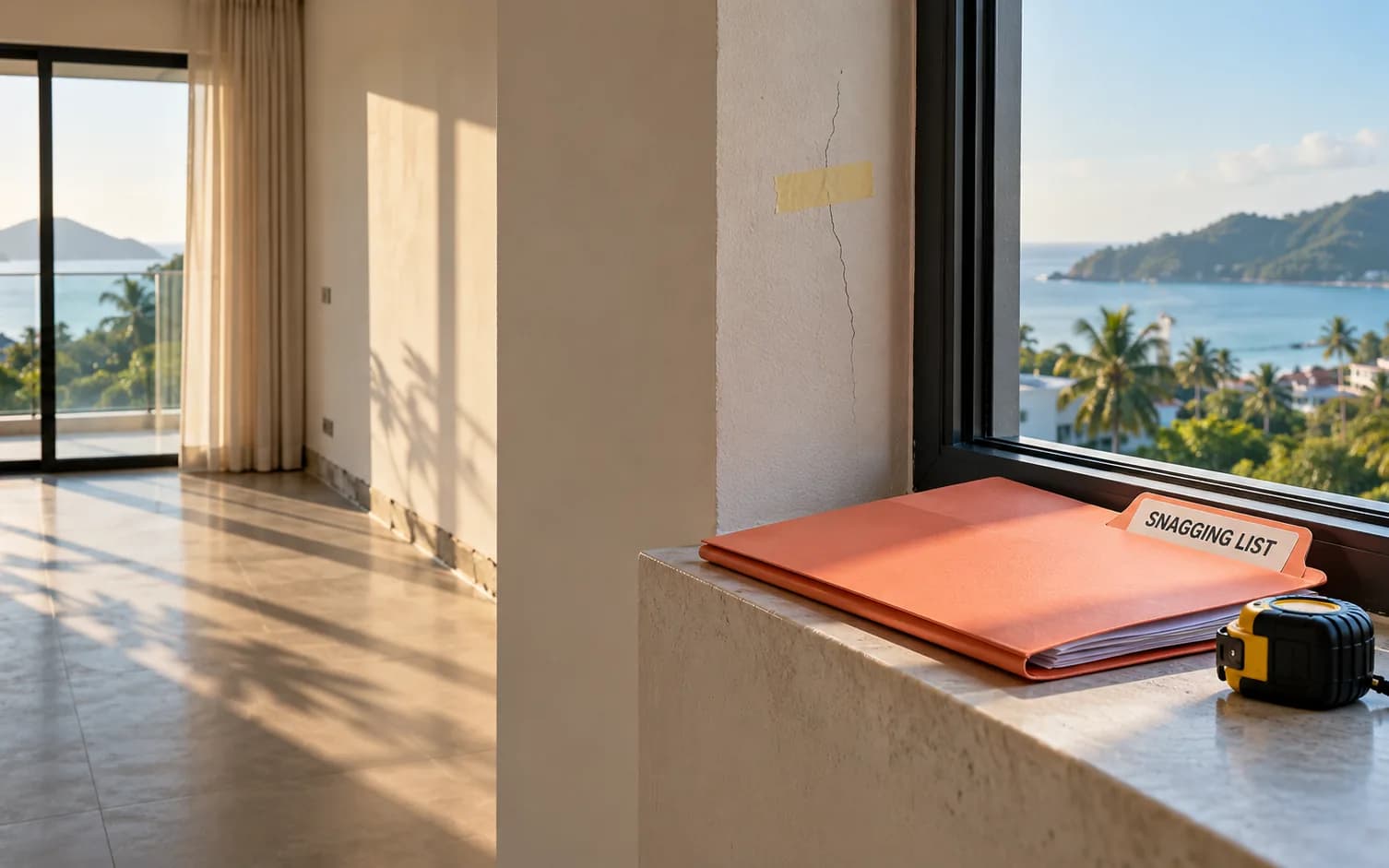
If you bought your unit from the developer and find cracks, leaks or faulty wiring in your Phuket condo after you have already picked up the keys, the developer can be responsible for fixing them under your contract and the law — whether you can claim depends on the defect, what you recorded at handover and whether you act in time. The standard condominium sale contract that every developer in Thailand must use gives you at least 5 years' warranty on the structure and 2 years on other parts (Condominium Act s. 6/2). Do not wait and see if the problem gets worse: notify the developer in writing as soon as you find a defect, and bring your claim within one year of discovering it (Civil and Commercial Code s. 474).
In short
- The standard contract form gives at least 5 years' warranty on the structure and 2 years on other parts.
- Thai sources say the warranty period is counted from the registration of the condominium, not from the day you got the keys — check the date in your own contract.
- You have one year from discovering a defect to act, and you should notify the developer in writing immediately.
- Write every visible defect into the handover record before you sign it; accepting a unit without reservation can cost you the claim later.
- In a consumer purchase from the developer, an "as is" clause does not let the developer escape responsibility for defects you did not know about when you signed (Unfair Contract Terms Act s. 6).
| Defect | What applies | How long | What to do |
|---|---|---|---|
| Structural parts of the building | Standard contract warranty (Condominium Act s. 6/2) | At least 5 years | Notify the developer in writing and claim within 1 year of discovery (CCC s. 474) |
| Other component parts | Same standard contract warranty | At least 2 years | Same notice and 1-year claim window; check the standard form and your own contract for what counts as "structure" versus "other component parts" |
| A defect you could see at handover | CCC s. 473: a defect accepted without reservation may bar the claim | No separate period — must be flagged before you sign | Write it into the handover record before signing |
| Common-area defects (lobby, pool, building roof) | Same warranty, reported through the juristic person | Same 5/2-year periods | Report to the manager; shared decisions may need a general meeting |
| Work by a contractor you hired yourself | Civil and Commercial Code ss. 600–601 (a separate regime) | Set by ss. 600–601 and that contract together | Check that contract and these rules separately — not covered here |
Handover: what to record
Under Civil and Commercial Code s. 473, a buyer who accepts a unit without raising an objection to a defect they could see can lose the right to claim over that defect later. This makes the handover inspection the most important hour of the whole purchase, and it is worth treating it that way rather than rushing through it to get the keys.
At handover, we advise going through the unit with a written checklist and marking anything wrong before you sign the handover record, not after:
- walls and ceilings — cracks, uneven surfaces, paint defects
- waterproofing and damp — around windows, bathrooms and balconies
- windows and doors — that they open, close and lock properly
- plumbing — water pressure, drainage, leaks under sinks
- electrical points and switches — that everything is wired and live
- air-conditioning — that each unit cools and drains correctly
- flooring — scratches, uneven tiles, gaps
- balcony and railings — finish and fittings
Photograph and film every defect with the date visible, and ask the developer's representative to sign the list of defects alongside you. If your unit is managed by a letting agent or a property management company, tell them to keep the same habit: record each defect with a date as soon as it is noticed, and check with us whose discovery starts the one-year clock described below when it is someone other than you who finds the problem first.
This is a straightforward reading of s. 473, not a guarantee that every dispute over a visible defect will go your way — the facts of each handover still matter.
The developer's warranty: which defects and for how long
The Condominium Act requires every developer to use a standard sale and purchase contract set by the Ministry of Interior, and any clause that departs from it to the buyer's disadvantage is invalid (s. 6/2). That standard form is where the warranty periods come from: at least 5 years for the structural parts of the building and at least 2 years for other component parts — check the standard form for what counts as which category.
Thai sources describe the warranty as running from the date the condominium building itself is registered, not from the day you received your keys. Registration and handover can fall on different dates, so check which date your own contract names before you count the years. Our lawyers check this clause against the standard form whenever a client sends us a condominium contract, because developers sometimes word it loosely.
Whether a buyer who purchased the unit on the resale market, rather than from the developer, can rely on this same warranty is not officially settled. If you bought second-hand and found a defect that looks like it predates your purchase, treat this as an open question and get advice before you rely on the developer's warranty alone.
How long you have to claim
Separately from the warranty period itself, the Civil and Commercial Code sets a deadline for acting once you have found a problem: you must bring your claim within one year of discovering the defect, and you should notify the developer in writing as soon as you find it (s. 474). How this one-year deadline interacts with the contract's own 5- or 2-year warranty period has no official answer yet; treat the one-year window as the deadline that matters whatever year of the warranty you are in, and have us check the point for your own case.
Keep a written record of the date you first noticed each problem. If a dispute reaches court later, that date is what starts the clock.
Writing and sending the claim
A written claim to the developer should cover:
- your unit number and the contract reference
- each defect, with the date you discovered it and supporting photographs
- the contract or warranty clause you are relying on
- what you are asking the developer to do
- a reasonable deadline for a response
Write the claim in the language your contract is in. Send it in a way that leaves proof it was delivered, such as registered post or email with a read receipt, and send a copy to the condominium's juristic person so the building's management is also on record. We prepare claims like this in two languages when a client's contract is bilingual, so the developer and the client are reading the same document.
We do not set out a template claim letter with a signature here, because the right wording depends on your own contract and the defects you found. If you send us your contract and photographs of the defects, we will tell you what you can reasonably claim and by when.
Common-area defects: the juristic person's role
Defects in shared areas — the lobby, the pool, the lifts, the building's roof — are best reported to the condominium's manager as well. Decisions on shared property follow the condominium's voting rules: a quorum of at least a quarter of all votes, or none at all if a meeting is validly re-called within 15 days of a failed first attempt (Condominium Act s. 43).
Whether the juristic person itself is entitled, or obliged, to pursue the developer over common-area defects is not something we can state as settled law, so we do not claim either way here. What we can say is that raising the issue through the manager and the general meeting is the route the Act sets up for shared property, and it is worth doing in parallel with any claim you make about your own unit.
If the developer ignores you: mediation and court
Start with direct negotiation, with a clear written record of the defects and the warranty clause in front of the developer. If that does not lead anywhere, a claim against a developer over defects in a condominium you bought for your own use is a consumer case under the Consumer Case Procedure Act. That gives you some real advantages: there is no court fee, you can file your claim orally rather than in a formal pleading, and on technical facts about the construction, design or service that only the developer could reasonably know — such as what caused a structural problem — the burden of proving those facts falls on the developer, not on you (Consumer Case Procedure Act s. 29). The time limit for your claim is also suspended while you and the developer are negotiating (s. 14).
We do not promise a particular outcome or a timeline for a case like this, and no rule fixes how long it takes or what it costs — that depends on the facts and the court's own calendar.
What is still unclear
A few points are genuinely open right now, and we would rather say so than guess:
- The cabinet approved a consumer-protection "lemon law" bill on 16 June 2026, but it has not become law, and there is no official word on whether it would cover condominium units if it does.
- Whether the warranty clock runs from the condominium's registration date or from some other date is a point Thai sources describe differently; check the date named in your own contract against the condominium's registration record and the standard form it must follow.
- Whether a second-hand buyer can rely on the developer's original warranty is not officially settled.
- Whether you can lawfully refuse handover or withhold the final payment over unresolved defects has no official guidance either way.
What to do next
If you have already found defects, start with the handover record and your contract's warranty clause, and put your claim in writing before the one-year window narrows. If you have not yet moved in, use the inspection checklist above before you sign anything.
Our free 48-hour review of a purchase contract covers this warranty clause specifically, among other points. If a dispute with your developer has already started, a lawyer in Phuket for disputes with developers can look at your contract and the defects you have recorded and tell you what is worth pursuing and by when.