Questions?
We reply within 24 hours, free of charge.
Contents
- In short
- Why off-plan carries more risk than a finished condo
- Buying off-plan from abroad: what's different from home
- Escrow in Thailand: when it exists and what it covers
- Payment schedules tied to construction stages
- What to check about the developer and the land
- If the developer is late with handover
- What the contract must say before your first payment
- What next
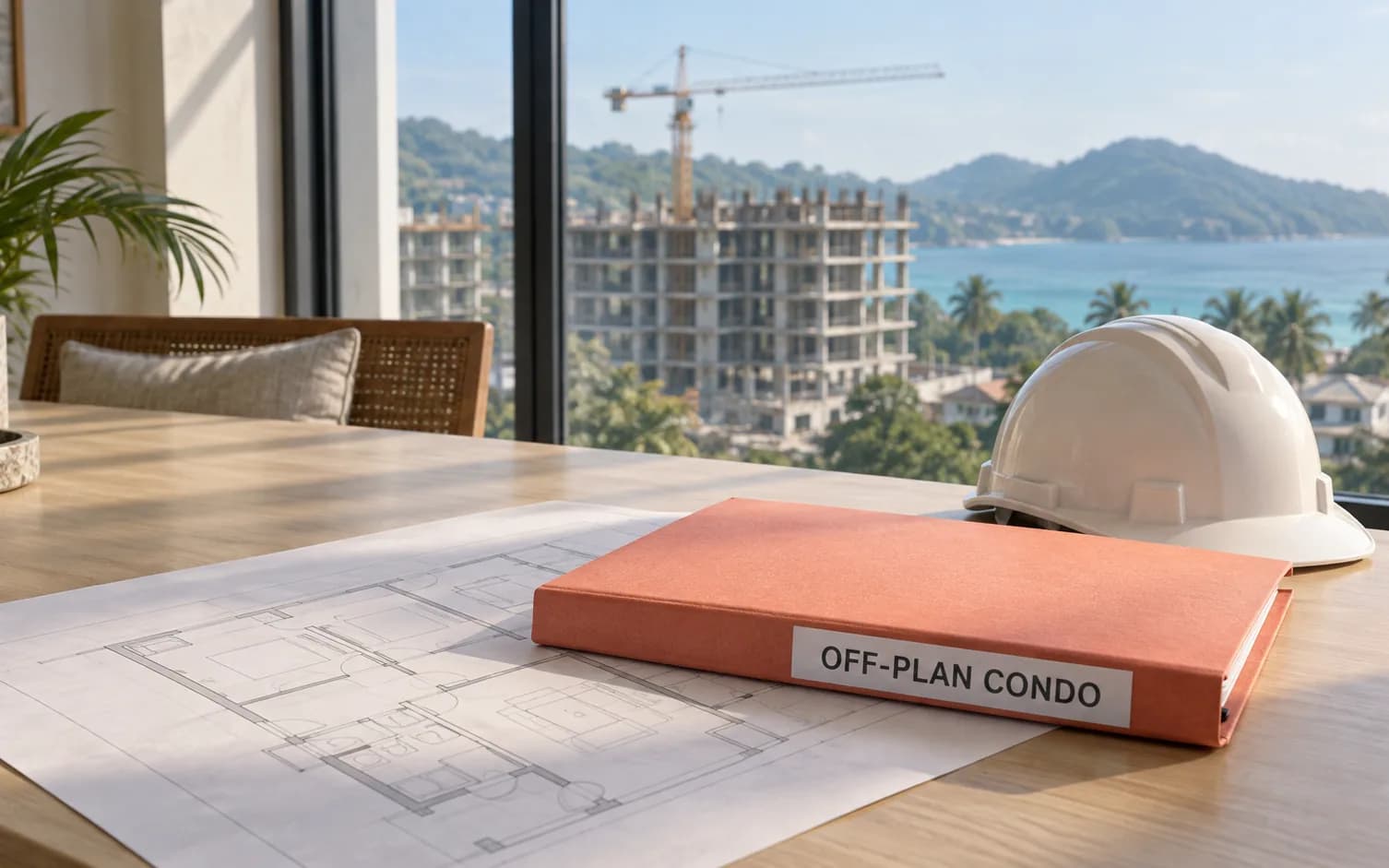
If you are buying a condo off-plan in Phuket, Thai law does not require your money to sit in an escrow account. The Escrow Act B.E. 2551 (2008) makes escrow available, not mandatory, and most developers take payments straight into their own account. Since 31 January 2025, condo reservations have been a controlled business under an Office of the Consumer Protection Board (OCPB) notification: the form is standardised, and a developer cannot waive its own liability for late delivery or keep your money when you have not broken the contract. Escrow and payments tied to construction stages only apply if you negotiate them and put them in the contract before the first payment leaves your account; a penalty for delay depends on what the contract says and the mandatory rules that apply to it.
In short
- Escrow is optional. You negotiate it with the developer, and only some banks offer it (Escrow Act B.E. 2551).
- Condo reservations have been a controlled business under OCPB rules since 31 January 2025: a standard form, with unfair clauses banned.
- A schedule tied to construction stages can reduce how much you've paid out before the work is done, if payment sizes and stage confirmation are properly agreed; release funds at registered title transfer, not "construction complete."
- Before paying anything, check the developer, the land, the building permit, condo registration and the foreign quota.
- If handover slips, the contract's wording on the date, penalties and termination decides what you can do - the law gives you a floor, not a guarantee.
Why off-plan carries more risk than a finished condo
With a finished unit, you can walk through it and compare it against the condo's registration before you pay. Off-plan reverses that order: your money leaves months, sometimes years, before the unit and your name on the title exist. In that gap, construction can run late, stall or get cancelled; the developer can change the layout or floor area; and the foreign quota available for the building can shrink before your registration date. A regulated reservation already bans a clause letting the developer make unilateral changes like these, but a ban in the rules does not rule out the developer breaching it in practice - your protection is a mix of what the rules already require and what you put into your own contract.
Buying off-plan from abroad: what's different from home
Buyers from the UK, the US or Australia often carry over an assumption from home about how client money is held during a purchase. Don't carry that assumption into Thailand: check in advance who the money goes to and under what conditions it's held. An escrow account exists only if the developer agrees to one, and most developers take payments directly into their own account instead.
That gap matters most off-plan, because that is exactly where your money and the asset are furthest apart in time. If you are signing a reservation or a sale and purchase agreement while still in London, Sydney or Los Angeles, get the Thai-language contract translated first, confirm in writing who the funds go to and when, and have your own lawyer review it rather than the developer's summary of it. Check in advance whether signing by a representative is possible for this purchase, what scope of authority a power of attorney would need to cover, and what the relevant Land Office requires from that document - and settle the contract terms before you grant one.
Escrow in Thailand: when it exists and what it covers
Escrow means a third party holds your money and releases it to the seller only once a condition in the contract is met. The Escrow Act B.E. 2551 (2008) sets the frame: the agent has to be a commercial bank or an institution licensed by the Ministry of Finance, and if the parties never agreed who pays the agent's fee, the cost is split equally. None of this is mandatory for a property purchase: no law forces a developer to open an escrow account, most take payments directly, and only some banks offer it at all. Escrow shows up in your purchase only if you ask for it and the developer agrees.
The release condition matters more than having an account at all. We recommend tying it to registered title transfer at the Land Department, not to "construction finished" - a phrase that is easy to claim and hard to verify from abroad. Registered transfer shows up as an official document in your name, so there is something concrete to check.
Payment schedules tied to construction stages
Compare two ways to structure the same payments: by date, or by construction stage. A date-based schedule pays out on fixed calendar dates regardless of how the build is going. After any agreed initial payment, a stage-based one links further payments to completed milestones - foundation, structure, roof and facade, interior fit-out, final payment at registered title transfer.
Here is a hypothetical, not a real project or a market norm: a unit priced at $165,000 (about ฿6,000,000), where construction stalls after the structure stage, 15 months after signing.
| Payment | Date-based schedule | Stage-based schedule |
|---|---|---|
| 1st | At signing, 25% - $41,250 | At signing, 10% - $16,500 |
| 2nd | +6 months, 25% - $41,250 | After foundation, 15% - $24,750 |
| 3rd | +12 months, 25% - $41,250 | After structure, 20% - $33,000 |
| 4th | At handover, 25% - $41,250 | After roof and facade, 25% - $41,250 |
| 5th | - | After interior fit-out, 20% - $33,000 |
| 6th | - | At registered title transfer, 10% - $16,500 |
| Paid by month 15, structure only | $123,750 (75%) | $74,250 (45%) |
When our lawyers read a payment schedule, the first thing they check is how much money the developer will already hold if the building stalls while it is still just a frame. The less you've paid out at that point, the less of your money is exposed.
A stage-based schedule only works if the contract says how each stage gets confirmed - an engineer's letter, dated photos, a milestone sign-off - ideally from someone other than the developer alone.
What to check about the developer and the land
Before the first payment, check the developer's registration and filed accounts in the DBD DataWarehouse+ database, and for larger projects, the Environmental Impact Assessment (EIA) approval in the ONEP database. Then check the building permit, the Chanote title to the land, the condominium registration and a current letter confirming the foreign quota.
Under section 19 bis of the Condominium Act B.E. 2522, foreign ownership is limited to 49% of the total floor area of all units in the registered condominium, and the buyer also has to qualify under section 19. That quota can run down before registration - ask for a fresh letter twice, once before you commit and again just before registration. As a general rule, under the Land Code (section 86), foreigners cannot own land outright in Thailand. The 49% condo quota explains how to confirm it before you pay, and property due diligence in Phuket covers the fuller checklist.
If the developer is late with handover
Whether you can get money back depends on the contract and the rules that apply to it, and getting it in practice is never guaranteed - that still depends on whether the developer can pay. If handover has slipped, we start the same way every time: with a timeline.
- Find the handover date in the contract, along with any grace period, the late-delivery penalty and the conditions under which you can terminate.
- Collect the reservation, the contract, the payment schedule, receipts, bank transfer records and all correspondence with the developer, and put them in date order.
- Ask the developer in writing for a new handover date and a completion schedule.
- Choose a path: wait with a written compensation clause, swap for a finished unit, or terminate the contract.
- If you terminate, send a written claim and work toward a termination agreement that states a figure and a repayment schedule.
OCPB rules ban a reservation clause that waives the developer's liability for late delivery; whether that reaches reservations signed before 31 January 2025 is something to check against the specific contract. The main sale and purchase agreement is separate from the reservation, and we read it on its own - its clauses on timing and penalties can differ.
How a deposit came back after a one-year delay walks through how this kind of dispute can play out - it is a typical situation assembled from practice, not one client's file.
What the contract must say before your first payment
Beyond the OCPB baseline, go through this table before you sign anything or pay a deposit.
| Contract clause | What it gives you |
|---|---|
| Escrow or payments tied to construction stages | Holds back part of the price until an agreed milestone, if the schedule or escrow agreement actually says so |
| Fund release tied to registered title transfer | The final payment moves only once the unit is registered in your name |
| Handover date and a capped grace period | A clear point after which delay counts as a breach |
| Penalty for late delivery | Compensation for waiting, if the rate and how it's calculated are written down |
| Right to terminate and a timeline for the refund | A defined exit, with a figure and a deadline attached |
| Ban on changing the layout or floor area without your consent | Locks in the unit you agreed to buy |
| Ban on forfeiting your reservation money without a breach on your part | OCPB rules ban this clause; the grounds, process and timing for any refund still need checking against the rules in force and your own contract |
| Assignment terms | Whether you can sell your position before handover depends on the contract; OCPB rules ban a developer charging a fee just for assigning the reservation itself - check the main contract's own assignment terms separately |
| What happens if the foreign quota runs short at registration | A clearly stated right to a refund, and how that refund would work, if registration becomes impossible for this reason |
| Governing language | The Thai reservation form is standardised - ask for a translation and confirm which version controls |
Before you send the first payment, also check:
- the invoice account matches the escrow agent or developer named in the contract;
- every payment is tied to a stage, and every stage has a way to confirm it is done;
- the contract states a handover date, a penalty and a right to terminate;
- the foreign-quota letter is recent and names this building;
- you hold a signed copy of the Thai-language reservation and a translation;
- the developer shows up in DBD DataWarehouse+ and the project has a building permit.
The rest of the pre-deposit checks are in the Phuket condo buyer's checklist.
What next
Send us the contract or the reservation form. Our team reviews it within 48 hours and flags the clauses that put you at risk, plus the questions worth putting to the developer before you pay anything. Our lawyers are licensed by the Thai Lawyers Council, and we prepare documents in Thai and English.
If you decide to go ahead, our lawyers can handle the purchase from reservation through to registration at the Land Department. The cost of that support is [price], fixed before work starts. Buying a condo in Phuket describes how we run that service.
Phuket areas
The same laws apply across the island, but each area has its own particulars: what kind of property usually sells there, which documents prove rights to the land and what deserves a closer look before you buy.

Kata
In sea-view condominiums the 49% foreign quota usually runs out quickly, so we check it before you reserve a unit.

Patong
People buy condos here to rent out and open businesses that need licences.

Kamala
There are many branded residences here, homes sold under a hotel brand, and the management agreement needs careful reading before you buy.
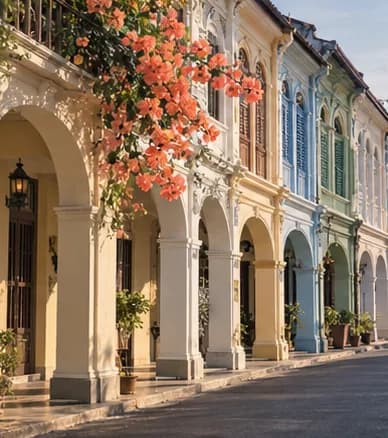
Old Town
Many historic shophouses, buildings with a shop on the ground floor, are protected and can only be restored under special rules.