Questions?
We reply within 24 hours, free of charge.

Knowing when to sell a Phuket property starts with one date: five years from the day you bought it. Sell before that date and, as an individual, you usually pay Thailand's Specific Business Tax (SBT) of 3.3% on the sale — unless you have been registered in the property's house book (tabien baan) for at least a year. Sell after five years and stamp duty of 0.5% replaces SBT; the two are never charged together. Withholding tax moves with the calendar too, so the date you actually register the transfer at the Land Office — not the date on your sale contract — changes how much lands in your account more than most sellers expect.
In short
- For an individual seller, five years of ownership — or a year on the house book — is the line between the 3.3% Specific Business Tax and the 0.5% stamp duty; a company seller pays SBT regardless of how long it has held the property.
- A year or more in the house book can exempt you from SBT even before five years.
- Withholding tax is worked out from the government-appraised value and how many years you held the property.
- Selling a condo to a foreign buyer only works while the building's 49% foreign quota has room left.
- You can sell by power of attorney without flying back to Thailand, if the signature is certified correctly first.
How holding period changes the seller's taxes
The five-year line applies to individual sellers. If you sell within five years of buying and have not been on the house book for at least a year, the Land Department collects SBT of 3.3% of the higher of the sale price and the government-appraised value. After five years, or with a year or more on the house book, stamp duty of 0.5% applies instead. A company seller pays SBT on every sale, regardless of how long it has held the property, and never gets the stamp-duty option.
| Seller | SBT (3.3%) | Stamp duty (0.5%) | Withholding tax | Transfer fee (2%) |
|---|---|---|---|---|
| Individual, under 5 years, not on house book | Yes | — | Progressive, by appraised value and years held | Yes |
| Individual, 5+ years, or 1+ year on house book | — | Yes | Progressive, by appraised value and years held | Yes |
| Company | Yes, always | — | 1% of the higher of appraised value or price | Yes |
Who actually pays each item is a matter of contract, so it should be spelled out rather than assumed. The common practice on a resale is that the transfer fee splits equally between buyer and seller, while the seller alone carries the SBT or stamp duty and the withholding tax. Before you set an asking price, check which version your draft contract uses, and confirm each party's tax liability separately — it changes what you keep.
The tax base differs by payment: the transfer fee and an individual seller's withholding tax are calculated from the government-appraised value, while SBT, stamp duty and a company seller's withholding tax use whichever is higher — the appraised value or the price you agree with the buyer. A new Treasury Department valuation cycle is expected to start on 1 January 2027; we don't yet have a confirmed percentage for how appraised values will move, so we treat this only as a reason to compare a sale now against a sale next year, not as a fixed number.
Selling a condo to a foreigner: quota and FET
The Condominium Act lets foreigners own units only within a 49% quota of the registered condominium's total saleable floor area — not of the whole building including common areas, and not a simple count of units. Before you accept an offer from a foreign buyer, check how much of that quota is still free — a willing buyer cannot register the purchase if the quota is full, whatever the sale contract says.
A foreign buyer registering ownership under Condominium Act s. 19 on the basis of money brought into Thailand in foreign currency needs a Foreign Exchange Transaction form or a bank certificate confirming the inbound transfer. A foreign buyer who is a permanent resident of Thailand can register under a different basis of s. 19, without that inbound-transfer requirement — check with the Land Office which basis applies to your buyer. We haven't found one confirmed threshold that applies to every case, so we advise confirming with the buyer's bank which document it will issue and what it requires before you sign.
If your buyer is a Thai individual, a separate incentive — a 0.01% transfer fee instead of 2%, up to a THB 7 million price and appraised value — can change what the buyer is prepared to pay in fees, which matters if your contract splits the transfer fee equally. Cabinet meant this to run from 1 July 2026 to 30 June 2027, but it only takes effect once the Ministry of Interior's notifications are published in the Royal Gazette, so confirm with the Land Office that it already applies before you rely on it. Foreign buyers pay the full 2% and get no discount under this measure.
Before listing to a foreign buyer, our team checks the building's quota and confirms with the juristic person how much room is left. See a 49% quota check for a Phuket condo and a related typical case where the quota ran out before closing.
Selling a villa on leased land
For a villa held through a registered land lease — up to 30 years, often paired with superficies over the house — selling means transferring your rights to the buyer, and exactly how depends on what the lease contract and the registered rights over the house allow. Assigning the existing lease to a new tenant and registering a brand-new lease in the buyer's name are two different operations, not interchangeable ones. Registering a new lease costs 1% of the total rent plus 0.1% stamp duty — that figure is the cost of a new lease, not necessarily of assigning an existing one.
Before we put a leasehold villa on the market, our lawyers check three things: whether the original lease contract actually allows assignment to a new tenant, how any renewal promise is worded, and who holds superficies over the house. The Supreme Court has ruled that pre-agreed renewals for a second and third 30-year term — the so-called "30+30+30" structure — are not enforceable, so a buyer's lawyer will look for this clause too. We haven't confirmed a single tax treatment for a leasehold assignment itself, so our lawyers check this case by case against the specific lease and sale structure rather than quoting one figure.
For how leasehold ownership works day to day, see freehold or leasehold in Thailand, buying a villa on a leasehold, and the 30-year lease ruling on renewal promises.
Moving the proceeds abroad
Before agreeing a closing date, ask your bank whether it can remit the sale proceeds overseas and on what terms. We advise keeping every document from the purchase and the sale, including any Foreign Exchange Transaction form or bank certificate from when you originally brought the money in, and asking your bank in advance which documents it wants.
If you plan to carry cash instead, Thai Customs requires a declaration for amounts over THB 450,000 or the combined equivalent of USD 15,000. Taking baht banknotes out of the country is capped at THB 50,000 for most destinations, including Russia; larger amounts, up to THB 2,000,000, are allowed only when travelling to Vietnam, Yunnan province and some neighbouring countries.
Selling remotely: power of attorney and timing
You don't have to be in Thailand to sell. A power of attorney completed on the Land Department's own form — Tor Dor 21 for land held with a title deed, Or Chor 21 for a condominium unit — witnessed by two people, lets your representative sign at the Land Office on your behalf.
If you sign the power of attorney outside Thailand, you may need notarisation, authentication by the relevant authority in the issuing country and legalisation by a Thai embassy or consulate — though the Land Office's own form also allows certification by an embassy, consulate or notary public, which is why missions apply the chain differently. From 28 February 2027, when the Apostille Convention enters into force for Thailand, an apostille should be able to replace consular legalisation for documents from other member states that raise no objection to Thailand's accession, but how the Land Office will apply this to a power of attorney is not yet confirmed. Before you set a closing date, our lawyers check the current requirement with the embassy and with the Land Office that will handle the registration.
What is not settled yet
- The size of the appraised-value increase expected from the 2027 Treasury valuation cycle.
- Whether the 0.01% transfer-fee incentive for Thai buyers will extend past 30 June 2027.
- The exact bank rules for a foreign seller repatriating sale proceeds.
- The tax treatment of assigning a leasehold right from seller to buyer.
We watch all four and will update this guide when an official position is published.
What to do next
If you're weighing a sale now against waiting out the five-year mark, the numbers are specific to your purchase date, your house-book status and the current appraised value. Send us your purchase details, and our lawyers will calculate the seller's tax for both dates so you can compare them side by side (расчёт налогов продавца [price]). If you'd rather talk the sale through first, speak to a property lawyer in Phuket.
Phuket areas
The same laws apply across the island, but each area has its own particulars: what kind of property usually sells there, which documents prove rights to the land and what deserves a closer look before you buy.

Kata
In sea-view condominiums the 49% foreign quota usually runs out quickly, so we check it before you reserve a unit.

Patong
People buy condos here to rent out and open businesses that need licences.

Kamala
There are many branded residences here, homes sold under a hotel brand, and the management agreement needs careful reading before you buy.
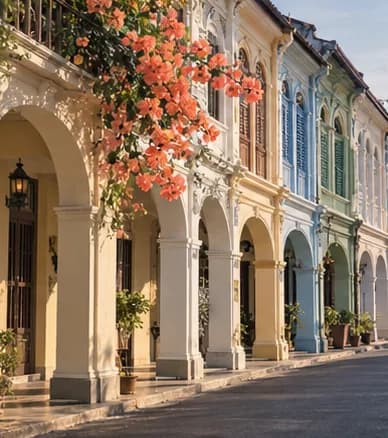
Old Town
Many historic shophouses, buildings with a shop on the ground floor, are protected and can only be restored under special rules.