Questions?
We reply within 24 hours, free of charge.
In Phuket you can buy a condo or a villa direct from the owner or through an agent, and the law treats both deals the same way: a sale is valid only once it is made in writing and registered at the Land Office (Civil and Commercial Code, section 456). An agent here is a broker under the Civil and Commercial Code. He is paid for bringing the parties together; as a rule he does not answer for the seller keeping his word, unless he concealed who the other party is, and his own contract with his client may add duties beyond that. When you buy a Phuket property direct from the owner, even that preliminary sorting disappears, so checking the owner, the title deed and the contract is entirely up to you and your lawyer.
Key points
- A sale of land, a house or a condo is valid only in writing and once it is registered at the Land Office.
- As a rule, the agent does not answer for the seller keeping his promises, unless he concealed who the other party is; his own contract may add more.
- We found no law that licenses property agents in Thailand.
- Escrow is voluntary; developers often still take payment directly, and other sales settle however the contract says.
- Check the original title deed and the registration record at the Land Office before you pay a deposit.
What an agent does and what a lawyer does
Under the Civil and Commercial Code, sections 845 to 846, a broker earns commission only if the contract was concluded because of his work; where the deal depends on a condition, commission is due only once the condition is met, and if the parties never agreed an amount, the customary rate applies. Section 848 goes further: the broker does not answer for the other party performing the contract, unless he concealed that party's name. By default he also has no authority to accept payment on anyone's behalf (section 849).
None of this makes an agent dishonest. It means his job is introduction, not verification. Our lawyers work for the buyer and check what an agent has no automatic duty under sections 845 to 849 to check, though his own contract with his client may cover some of it: who actually owns the property, what is written on the title deed, and whether the contract protects you if something goes wrong later.
| Agent | Lawyer | Buying direct | |
|---|---|---|---|
| Works for | Whoever engaged him, on the terms of their agreement | The client who hired the lawyer | You negotiate with the seller yourself |
| Duty to check the title | No automatic duty under sections 845-849; his own contract may add one | Checks the deed and the registration record at the Land Office | Nobody checks unless you arrange it |
| Drafts the contract | May offer a template; check it against your deal | Drafts or reviews the contract for the client | Whoever the two sides agree on |
| Can hold the deposit | No, unless the seller gives him that authority; put it in writing to be sure (section 849) | Holding client money needs its own authority; under the Escrow Act, funds go to a licensed escrow agent | Normally the seller, unless you set up escrow |
If you are buying through an agent, that does not replace a lawyer. If you are buying direct from an owner, it only replaces the agent's part of the picture, so you can still look for a property lawyer in Phuket to cover the rest.
Buying direct from the owner: where the risks are
Until the transfer is registered at the Land Office, you are not the owner, and any money you paid is only a claim against the seller (section 456). Two situations show why that matters.
First, a double sale. If the same seller registers the property to a second buyer who paid and acted in good faith, that later registration generally stands, and the first buyer is left with a claim against the seller rather than the property (section 1300).
Second, forged or incomplete title. Forging a title deed carries six months to five years' imprisonment under the Penal Code; a criminal case does not automatically return the property to you, and whether a registration made on a forged deed can be undone needs its own legal assessment. A seller may also not be the sole owner: if the property is marital property, both spouses must consent to selling it (Civil and Commercial Code, section 1476), and what follows when that consent is missing needs checking case by case.
None of this is specific to a direct deal in law; the difference is practical. Ask what checks the agent has actually completed and what his contract requires — agents also carry their own anti-money-laundering duties under the Anti-Money Laundering Act, discussed below. Those checks do not replace an independent review of the seller, title and contract; buying direct removes even the agent's part, so arrange that review yourself, whether you buy directly or through an agent.
Agent licensing in Thailand: what we know
We found no law that licenses real-estate agents or brokers in Thailand, and no official statement confirming or ruling one out. Thai legal academics have proposed introducing a licensing regime, but that is a proposal, not a rule, and we found no official text of a bill or an enacted law adopting one.
Two rules do apply to agents today, though neither amounts to licensing. Real-estate agents and brokers are reporting entities under section 16(4) of the Anti-Money Laundering Act: they must identify their clients and file reports with the Anti-Money Laundering Office (AMLO). Separately, agency and brokerage work sits on List 3 of the Foreign Business Act, which restricts a foreign company's ability to run that business in Thailand without a Foreign Business Licence or another lawful route.
We cannot say today where the line sits for an individual working informally, or what the AMLO reporting threshold is in practice from the materials we checked; confirm both directly with AMLO before relying on them.
Who drafts the contract and holds the deposit
Decide in advance who drafts the contract and who reviews it. It is drafted by whoever the two sides agree on, and an agent's standard template is not the same thing as a lawyer reviewing it for you. Where you buy a condominium unit from a developer, the Interior Ministry's standard contract form sets mandatory terms, and clauses that depart from it to the buyer's disadvantage are invalid (Condominium Act, section 6/2). For a villa or land purchase, have a lawyer check which mandatory contract requirements apply to the particular transaction before agreeing the terms.
Escrow is one answer to the question of who holds the deposit. Under the Escrow Act B.E. 2551, an escrow agent must be a commercial bank or an institution licensed by the Ministry of Finance, and using escrow is voluntary: developers often still take payment directly, and where no escrow is agreed, the contract should say who receives payment. Where you do use escrow, we advise tying the release of money to the registered transfer of title, not to a construction milestone that the seller controls.
For off-plan units, the Office of the Consumer Protection Board's notification on reservation agreements, in force from 31 January 2025, bans unfair clauses in the standard reservation form: a developer cannot make you waive its liability for late delivery, forfeit your reservation money when you are not in default, or charge a fee just to assign your reservation to someone else.
Section 457 of the Civil and Commercial Code provides for contract costs to be split equally between buyer and seller; its exact scope, and how it works alongside the contract and local custom, needs checking case by case, so agree each cost, tax and registration fee with the other side rather than relying on the section alone.
Checks to finish before you pay
Whether you found the property through an agent or direct from the owner, the checks are the same. We check the original deed and the registration record at the Land Office before any money moves, and this is the order we work through:
- Original title deed and registration record at the Land Office — not a photo or a copy.
- Who is actually the registered owner, and whether a spouse's consent is needed.
- The type of land document: a chanot gives full title with a surveyed boundary, while Nor Sor 3 and Nor Sor 3 Gor are weaker and not always convertible. See Thai land title deeds: chanote and other titles.
- For a condo, the 49% foreign-ownership quota and a debt-free certificate for common fees under section 29 of the Condominium Act. A typical situation shows what can happen when the quota ran out a week before closing.
- For a registered leasehold, the term (up to 30 years), the renewal clause and the right to transfer the lease. Our team reads the renewal and transfer wording line by line, because a leasehold is the ordinary way foreigners buy a villa in Phuket; a lease of land runs for at most 30 years (Civil and Commercial Code, section 540), and renewing it afterwards means a new agreement that is never guaranteed in advance, so how today's contract reads matters for what you can rely on later.
- Source of funds for land purchases: Land Office circulars from 15 May 2026 require checking a land buyer's source of funds under section 74 of the Land Code once cash payment reaches THB 2 million or the appraised value reaches THB 5 million, with Phuket named as a priority province; a foreigner's condo purchase is a separate matter governed by the Condominium Act's 49% quota, not by these circulars.
- No nominee arrangement behind the seller or the structure you are buying into.
- A contract in Thai and in your own language, agreed and reviewed before you pay a deposit, not after.
This is also where property and owner checks before you pay fit in, and where the Phuket condo buying checklist walks through the condo-specific steps in more detail.
What to do next
If you already have a draft purchase or reservation contract, send it to us: our lawyers will mark the risky clauses within 48 hours, free of charge. If you also have a copy of a title deed, send that too, and we'll tell you what further checks it calls for and what to verify at the Land Office before you commit. Where you want a fuller check, our service for checking the property and the structure behind it is priced at [price], and we agree the cost with you before starting.
Buying through an agent or direct from the owner are both ordinary ways to buy in Phuket. Neither one, on its own, checks the title for you, so property and owner checks before you pay are worth doing whichever route you take.
Phuket areas
The same laws apply across the island, but each area has its own particulars: what kind of property usually sells there, which documents prove rights to the land and what deserves a closer look before you buy.

Kata
In sea-view condominiums the 49% foreign quota usually runs out quickly, so we check it before you reserve a unit.

Patong
People buy condos here to rent out and open businesses that need licences.

Kamala
There are many branded residences here, homes sold under a hotel brand, and the management agreement needs careful reading before you buy.
Old Town
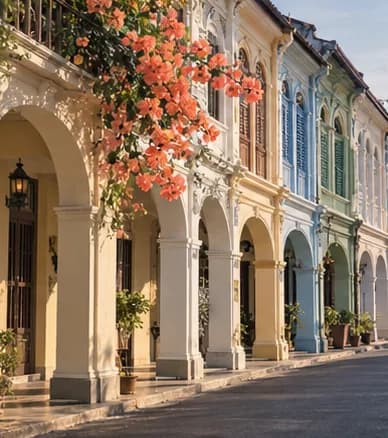
Many historic shophouses, buildings with a shop on the ground floor, are protected and can only be restored under special rules.