Questions?
We reply within 24 hours, free of charge.
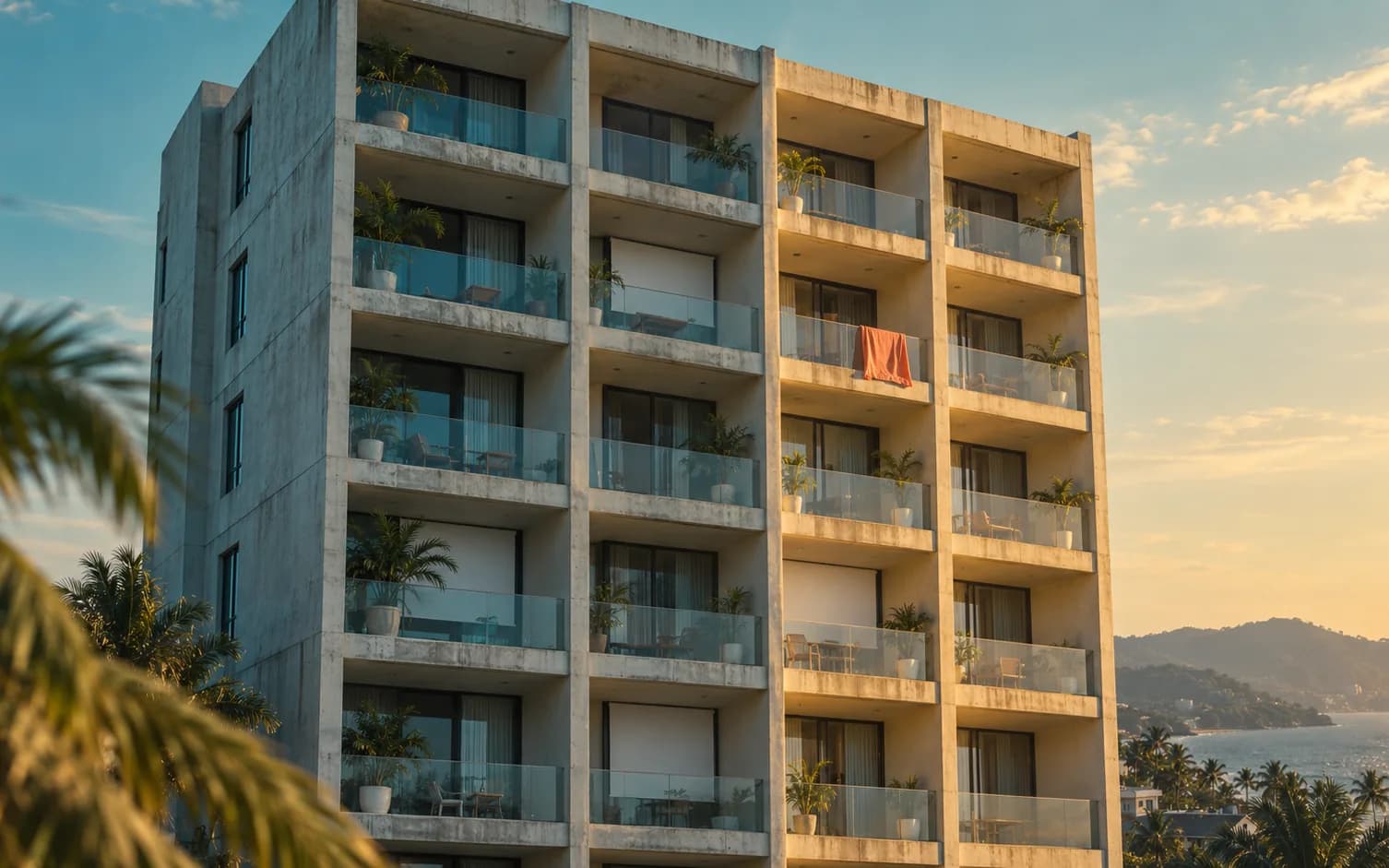
The 49% quota means foreigners can own no more than 49% of a condo building's saleable floor area. While that share is not used up, a foreigner can buy a unit outright. You check it before you pay in three ways: the letter from the condominium's juristic person (its registered management entity), a Land Department search and the developer's written confirmation. The remaining quota can change until registration, so you ask for the letter twice. If the quota has run out, two lawful routes remain: a resale unit from a foreign owner or a registered lease of up to 30 years. Rules are as of 6 October 2026.
In short
- Foreigners can own up to 49% of a building's saleable floor area. The test counts area, not units (Condominium Act B.E. 2522, s. 19 bis).
- Three checks confirm the quota: the juristic person's letter, a Land Department search and the developer's written confirmation. Ask for the letter before you pay and again before registration (terms.law, February 2026).
- If the quota has run out, you can buy a resale unit from a foreign owner or register a lease of up to 30 years. A nominee company is illegal (Thaiger, 3 July 2026).
- A 75% quota is still an idea: in April 2024 the Cabinet approved only a study (Thaiger, 3 July 2026).
- Under the rules of the Office of the Consumer Protection Board (OCPB), a developer cannot keep your reservation money when you are not in default. Read the refund terms in your own form (Palmora, 28 March 2026).
How is the 49% quota counted?
Foreigners in a building can hold no more than 49% of its saleable floor area, counted in square metres, not units. Section 19 of the Condominium Act B.E. 2522 says which foreigners may own a unit, and section 19 bis sets the ceiling (Tilleke & Gibbins, 2013). Units still on sale tell you nothing about the quota.
Here is an illustration with made-up numbers, not data from a real project. A building has 20,000 m² of saleable area, so foreigners can hold 9,800 m². If foreigners already hold 9,770 m², 30 m² is left. A 35 m² studio (about 377 sq ft) does not fit, even if it is still on the market: the developer can sell it to a Thai buyer, but not to you. A 200 m² penthouse uses as much quota as four 50 m² studios.
| Item (illustration only) | Value |
|---|---|
| Saleable area of the building | 20,000 m² |
| Ceiling for foreigners, 49% | 9,800 m² |
| Already registered to foreigners | 9,770 m² |
| Quota left | 30 m² |
| The unit you want | 35 m², does not fit |
The quota works alongside a second condition: the foreign buyer has to qualify under section 19. Usually that means the money came from abroad in foreign currency and a Thai bank converted it to baht (terms.law, February 2026). Without a bank document that shows you as sender or recipient, the Land Department will not register the sale (Montmari Asia, 25 November 2025).
How do you check the quota before you pay?
Three checks confirm it: a dated letter from the condominium's juristic person, a Land Department search by your lawyer and the developer's written confirmation. A letter is accurate only for the day it was issued, and the remaining quota can change until the sale is registered, so ask for a new one a few days before registration (terms.law, February 2026; Thaiger, 3 July 2026).
| What you check | Who provides it | What to read | When |
|---|---|---|---|
| Quota letter | The condominium's juristic person | Issue date, project name, area held by foreigners, remainder | Before you pay and before registration |
| The register | Land Department, searched by your lawyer | Whether the figures match the letter | Before you pay |
| Developer's confirmation | The developer, for new projects | That your unit fits in the remainder | Before you sign the contract |
| Contract clause: quota warranty | Your lawyer drafts it | A clause that the quota is confirmed and money comes back if registration is impossible | Before you sign |
Compare the remainder with your unit's area, not with a vague "the quota is fine". If the remainder is smaller than your unit, you do not buy. Ask for a quota warranty and a deposit refund clause in case registration proves impossible (Thaiger, 3 July 2026).
It is too early to pay if any of these is true:
- there is no letter, and the agent keeps saying "the quota is fine";
- the letter predates your reservation and has not been refreshed;
- the letter and the register show different figures;
- the developer will not confirm the quota in writing.
Deals filed after the letter was issued are not in it. Ask the developer to state in writing how many foreign sales are now at the Land Department. The answer decides whether your area will still be there on your registration day.
Buying off plan adds time: months pass between the contract and registration, and the quota can change in that time (terms.law, February 2026). So write into the contract what happens to your payments if no quota is left by then, and do not accept "quota risk sits with the buyer" without a refund. Tie payments to construction stages, not to dates (Palmora, 28 March 2026).
What can you do if the quota has run out?
When a building's quota has run out, two lawful routes remain for that building: a resale unit from a foreign owner, or a registered lease of up to 30 years. A resale unit brings its quota allocation with it, so the building's foreign share does not grow. A Thai nominee company is illegal (Thaiger, 3 July 2026; terms.law, February 2026).
| Route | What you get | Limit |
|---|---|---|
| Resale unit from a foreign owner | Ownership, with the unit's existing quota allocation | Ask the juristic person to confirm in a letter that the unit is in the foreign share; your choice is limited to what is for sale |
| Lease of up to 30 years | A registered right to use for the term | Renewal only by a new agreement; resale and mortgages are harder (terms.law, February 2026) |
| Another project | Ownership | You check the quota again |
| Nominee company | No lawful right | Criminal exposure and forced sale |
When the quota has run out, foreigners are offered a 30-year lease instead (Thaiger, 3 July 2026). According to terms.law (February 2026), such units resell for less and are hard to mortgage. Plan on 30 years and not a day more: the Supreme Court voided pre-agreed 30+30+30 renewals in judgment No. 4655/2566. The details are in The 30-year lease ruling: what a 30+30+30 promise is worth now, and Freehold vs leasehold in Thailand shows what each route gives you.
A nominee company is not a way out for a condo either. It breaches the Foreign Business Act, and the Department of Business Development (DBD) has been checking companies with foreign participation more closely in 2026. Villa held through a nominee company: DBD checks and lawful exits describes what it checks.
What happens to your deposit if the quota runs out?
Since 31 January 2025 an OCPB notification (B.E. 2567) governs condo reservations: a developer cannot keep your reservation money when you are not in default. The pages we could read do not give the allowed deposit size or the refund steps, so read the refund terms in your own form and put every claim in writing (Palmora, 28 March 2026).
Stop any payment that has not left your account and ask for a fresh quota letter. Ask the developer what happens to your reservation and payments if the quota runs out before registration, and who pays if the deal is cancelled. The other pre-deposit checks are in the Phuket condo buyer's checklist.
Will the quota rise to 75%?
Not so far: 75% is a proposal with no bill and no timetable. In April 2024 the Cabinet approved only a study, and as of 3 July 2026 Parliament has passed no amendment. Officials added that foreign voting rights at owners' meetings would stay at 49% even if the ownership share rose (Thaiger, 3 July 2026).
Policy talk in mid-2026 favours stricter enforcement of the current rules over a higher quota. Plan your purchase around 49% and leave any increase out of the maths.
Buying from the UK, US or Australia: money and paperwork
Send the money in pounds, US dollars or Australian dollars from an account in your own name, so the bank document shows you as sender or recipient, and ask the Thai bank for that document after every transfer. Sources disagree on the amount above which a Foreign Exchange Transaction (FET) form is required (Montmari Asia, 25 November 2025).
If you sign a power of attorney or an affidavit at home, it usually goes through a notary, your foreign ministry and the Thai embassy, then a Thai translation, though the exact order depends on the document and on who will accept it (Bangkok Translation, 16 August 2026). An apostille will replace the embassy step on 28 February 2027 for states that do not object (HCCH, 6 October 2026), and the objection window runs to about 30 December 2026 (Convention art. 12; Federal Apostille). Do not plan your timetable around the apostille. More in Apostille and Thailand: how to legalise documents now and what changes on 28 February 2027.
What next
Send us the contract or the reservation, and within 48 hours you get a free written express review: up to five risky clauses and questions for the developer. See how we run a purchase on Buy a condo in Phuket and Buy a freehold condo in Phuket. If you are weighing a lease, read Buy a leasehold condo in Phuket. The quota also applies to heirs: Inheriting a condo in Thailand as a foreign heir explains how.
Rules checked as of 6 October 2026.
Phuket areas
Same law, different practice: land types, titles and the usual risks by area.
Kata
Sea-view condos; the 49% quota runs out fast

Patong
Investment condos and rentals; business licences

Kamala
Branded residences; management agreements
Old Town
Protected shophouses; renovation under heritage rules