Questions?
We reply within 24 hours, free of charge.
To make a Thai will, bring your passport, a list of your Thai assets with the documents behind each one, your heirs' full details as they appear in their passports, and the name of the person you want as executor. Decide in advance which assets the Thai will covers and how it fits with your home-country will. Under Thai law an ordinary will must be in writing, dated and signed in front of two witnesses who are present together (Civil and Commercial Code, s. 1656). This checklist walks through what to prepare before your first meeting with a lawyer, so the meeting settles the will rather than collecting paperwork.
In short
- Bring a passport, your marital status and a copy of any home-country will.
- List every Thai asset with its own document: condo title, lease, bank details, company shares.
- Write down each heir's name as it appears on their passport, date of birth and relationship to you.
- Choose an executor who is willing to attend a Thai court hearing in person.
- Decide how the Thai will and your home-country will divide your assets, and ask whether a forced-heirship rule at home could still reach your Thai company shares.
Your own documents
Start with the papers that identify you and your family situation.
- Your passport, plus your address in Thailand and at home.
- Proof of marital status. If you are married, bring the marriage certificate. The surviving spouse's half of the marital property is outside your estate and cannot be given away by your will (CCC ss. 1625, 1533).
- A copy of your home-country will, if you already have one. Your lawyer needs it to make sure the Thai will does not accidentally revoke or clash with it.
We suggest starting with this group of documents even before the asset list, because your marital status changes how much of the estate you can actually dispose of.
Listing Thai assets: condo, land, accounts, shares
For each Thai asset, bring the document that proves you hold it:
- Condo: the title document for the unit.
- Villa or land bought as a leasehold: the registered lease agreement. Buying a villa on a leasehold is the ordinary way foreigners buy a house in Thailand, since land itself stays with a Thai owner; what matters for a will is how the contract is written.
- Bank accounts: which bank and branch holds each account.
- Shares in a Thai company: the company's name and its shareholder register.
| Asset | What to bring | What we check |
|---|---|---|
| Condo | Title document | Whether foreign ownership in the building still fits the 49% quota after the transfer |
| Leasehold villa or land | Registered lease agreement | How the contract records renewal and whether it names your heirs |
| Usufruct | Registration document | Do not assume a usufruct can pass under your will; ask your lawyer to check how the right ends on death |
| Land in your own name | Any permit from the Interior Minister | A foreign statutory heir needs the Interior Minister's permission under Land Code s. 93 to retain inherited land; if the heir has no right to retain it, the Director-General sets a disposal period of not less than 180 days and not more than one year under s. 94 |
| Shares in a Thai company | Share certificate or register | Whether the heir's nationality would bring foreign holding to 50% or more of the company's capital under the Foreign Business Act (s. 4) |
Heirs and their details
For every heir, write down their full name exactly as it appears on their passport, date of birth, relationship to you and current contact details. If an heir's documents are in another language, plan for a certified Thai translation.
Decide, too, who you are not leaving anything to. A will that disposes of your whole estate already leaves out any statutory heir it does not mention. You can also disinherit someone expressly, in the will itself or in a document filed with an official (CCC s. 1608).
If one of your heirs is a foreigner who will inherit a Thai condo, the 49% foreign quota (Condominium Act ss. 19/5 and 19/7) can affect whether they keep it or have to sell within a year. We cover that situation in our guide to inheriting a condo as a foreigner.
Choosing an executor
Bring the name and contact details of the person you want as executor, and get their agreement before the meeting.
Thailand has no English-style grant of probate. An executor can deal with your Thai assets only once a Thai court formally appoints them as administrator of the estate, and the proposed administrator has to attend that hearing in person. This matters most if your chosen executor lives abroad: they will need to travel for the hearing, not just sign papers from home.
We explain to clients, before they name an executor, what that court hearing will require, so the choice holds up in practice and not just on paper.
Witnesses and the form of the will
Thai law recognises five forms of will: ordinary, holographic (handwritten), public document, secret and oral (CCC ss. 1655-1663). The ordinary form is a written document, dated, signed by the testator in front of at least two witnesses who are present together (s. 1656).
Under the Civil and Commercial Code, the testator must be at least 15 years old and of sound mind. Bring to the meeting any questions about which form fits your situation; your lawyer will confirm the witnesses and the signing arrangements before the document is finalised.
Fitting the Thai will with your home-country will
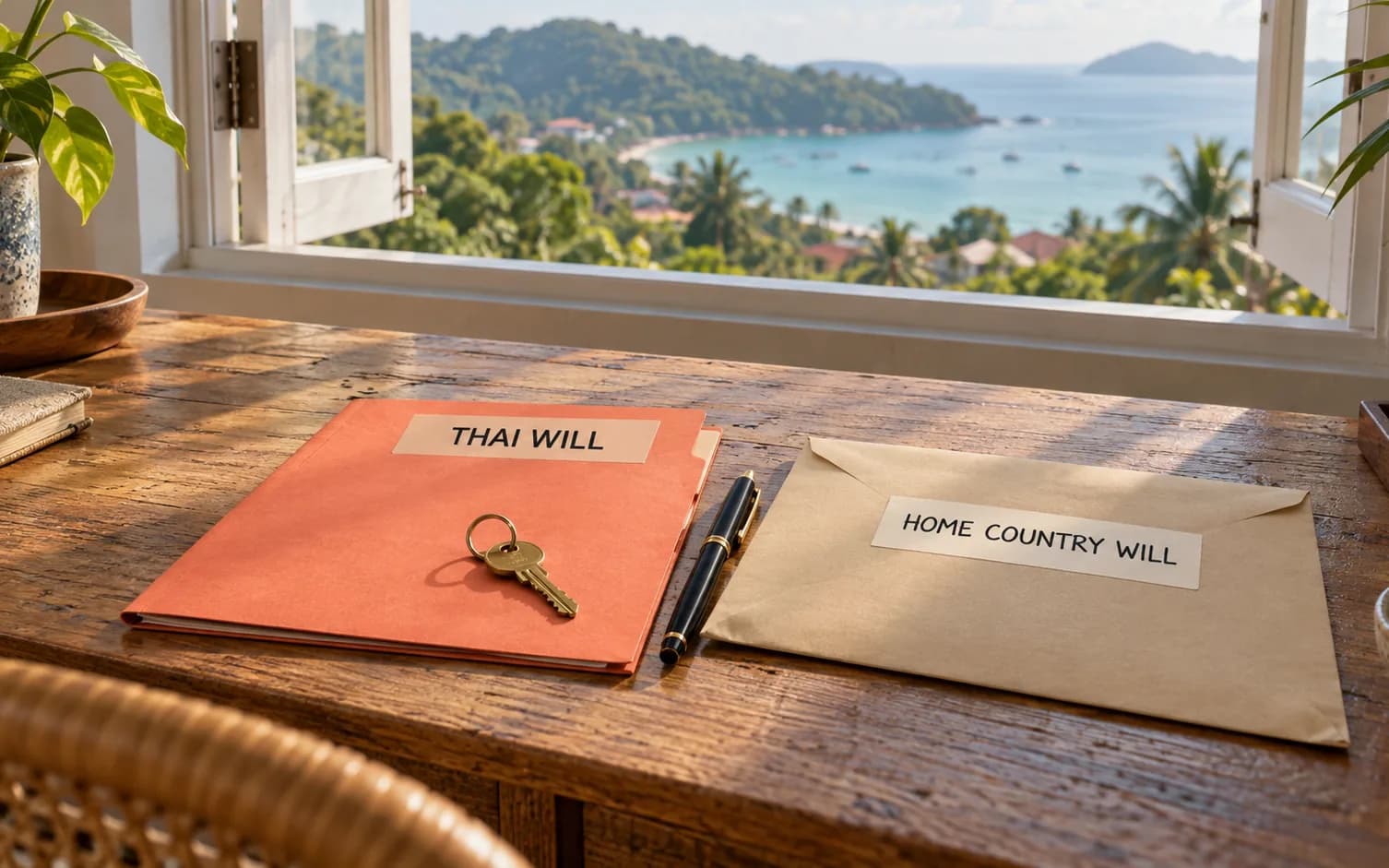
A common structure is a Thai will covering Thai-situs assets — the condo, the lease, the Thai bank accounts, the company shares — and a separate will at home covering everything else. This helps define which assets each will is intended to cover.
One point needs care if you hold shares in a Thai company. Shares are movable property, and Thai conflict-of-laws practice, as Thai lawyers describe it, sends movable property to the law of your domicile at death. That can let a forced-heirship rule from your home country — for example a statutory reserved share — reach your Thai company shares, even though Thailand itself has no forced heirship for Thai-situs land or a condo (CCC s. 1646). A foreign law has to be proved in a Thai court to apply; otherwise Thai law governs (Supreme Court No. 4027/2545). We recommend asking a lawyer in both countries before assuming either will controls your shares.
For how two wills are usually structured together, see how to make a will in Thailand; for how this worked out for one family, see the typical situation in two wills without conflict.
If you are planning this from the UK or the US: a UK grant of probate or US letters testamentary carries no weight in Thailand on its own. Whoever you name as executor at home still needs a separate appointment by a Thai court before they can touch Thai assets.
What is not settled yet
A few points in this area do not have a clear, official answer, so we flag them rather than guess:
- Whether a leasehold automatically passes to your heirs, or lapses unless they are named in the contract, is read differently by different practitioners. Our lawyers check the lease's wording, but an automatic transfer or the sufficiency of a contract clause alone cannot be assumed before that legal review.
- Whether a foreign heir who already holds Thai permanent residence can keep an inherited condo outright is not consistently described either. We confirm this with the Land Office case by case rather than assume it.
What next
Send us your asset list and your questions in Telegram or WhatsApp. We will answer within 24 hours: what needs to be done, how long it takes and what it costs, with the price fixed before any work starts. We prepare the will and the supporting documents in Thai and in English or Russian, as your situation needs. Our will and estate plan package is priced at [price] once we've seen the asset list. If you want a lawyer to help you decide the Thai will's structure from the start, our team can take that over as part of making a Thai will with a lawyer.