Questions?
We reply within 24 hours, free of charge.
Selling a foreign-quota condo to a foreigner is usually the easy part of a resale: the unit was already counted inside the building's 49% foreign quota, so one qualifying foreign owner stepping in for another does not add to that share. What takes work is the paperwork, because the Land Office treats a resale buyer exactly like a first-time buyer under section 19 of the Condominium Act B.E. 2522. The buyer still has to bring in money from abroad, convert it to baht through a Thai bank, and hand over proof the Land Office will accept. Sell to a Thai buyer instead, and the building's foreign-owned share actually falls.
In short
- The 49% quota is measured by floor area, not by how many times a unit has already changed hands.
- A foreign buyer still has to qualify under section 19: usually funds remitted from abroad and converted to baht through a Thai bank.
- Sell to a Thai buyer, and the building's foreign-owned share goes down, not up.
- The Land Office will not register the transfer without a letter from the juristic person confirming there is no unpaid common-expense debt on the unit.
- Who pays each transfer fee and tax is for the sale contract to say; the amounts themselves are fixed by law, not by the contract.
What happens to the quota on resale
Section 19 bis of the Condominium Act sets the number: the floor area owned by foreigners in a registered building cannot pass 49% of the building's total saleable floor area. Section 19 sets out who may count as a qualifying foreign owner. At a resale, the Land Office checks the new buyer against section 19 and checks the building's foreign-owned share against the 49% limit again; when one qualifying foreign owner steps in for another, the total floor area foreigners hold does not change.
In practice the quota can still move between the day you check it and the day the deal closes, because other units in the same project may be sold and registered in the meantime. That is one reason we advise asking the juristic person for a fresh quota letter close to the deposit, not only when you first looked at the unit, and having a lawyer confirm the figure against the Land Office's own record. The same freehold framework that applies when buying a freehold condo in Phuket for the first time governs a resale too; see how to check the 49% condo quota for what that letter should show and when to ask for it.
A foreign buyer: money from abroad and the FET
A foreign buyer of a resale unit meets the same test as any other foreign buyer under section 19. Bringing the purchase money from abroad in foreign currency and converting it to baht through a Thai bank is the common path, and the bank then issues proof - an FET form (formerly called a Thor Tor 3), a bank credit advice, or a transfer confirmation - showing the buyer as the sender or recipient and stating the purpose, typically "purchase of condominium unit No. ...". Section 19 also recognises other grounds, such as lawful permanent residence in Thailand or an investment-promotion basis, and those are checked against their own documents rather than against a bank remittance. Without the right proof for the buyer's own basis, the Land Office will not register the transfer.
Which document a bank will issue, and at what threshold, is not settled across sources, so our lawyers recommend asking the bank for a document on every transfer connected to the purchase, whatever the amount, rather than assuming a small transfer needs nothing in writing. We are not covering a baht-denominated mortgage here, because Thai banks' current practice on financing a resale this way has not been confirmed from an official source.
Selling to a Thai buyer: what changes
A Thai buyer does not need section 19's proof of funds from abroad, because the quota applies only to foreign ownership. Selling to a Thai buyer also reduces the building's foreign-owned floor area, which is useful information if the project is close to its 49% limit and other foreign owners are waiting to sell.
| Foreign buyer | Thai buyer | |
|---|---|---|
| Proof of money | Funds from abroad, converted to baht; FET form or bank credit advice | Not required by section 19 |
| Effect on the 49% quota | No change: one qualifying owner replaces another | Foreign-owned floor area decreases |
| Transfer fee rate | Standard 2% of the appraised value | May qualify for a reduced 0.01% fee up to THB 7M, a measure in force to 30 Jun 2027 |
| Who pays each fee or tax | Set by the sale contract | Set by the sale contract |
If the Thai buyer is married to a foreigner and pays with money the couple earned during the marriage, Thai law firms report that the unit is still treated as bought by the foreign spouse. That means it still has to fit inside the 49% quota, and the foreign spouse still has to satisfy section 19, even though the title is in the Thai spouse's name.
The quota letter and debt-free letter
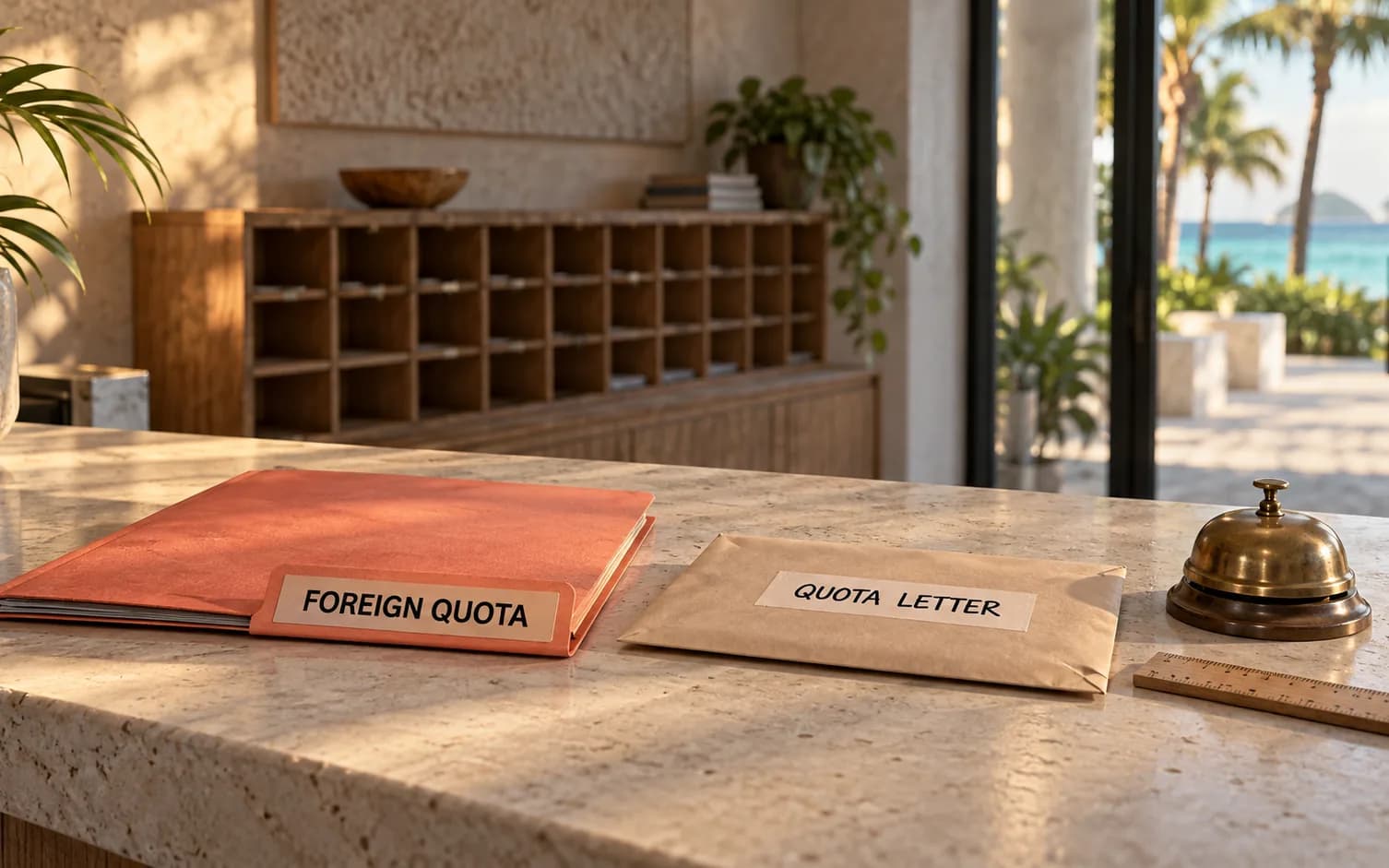
Two letters from the condominium's juristic person matter in a resale, and they answer different questions. The quota letter confirms how much of the building's foreign-owned floor area is free, which our team checks together with a Land Office search before the buyer commits to anything.
The debt-free letter is a separate requirement under section 29: the Land Office will only register the transfer once the juristic person certifies that the unit carries no unpaid common-expense fees. The letter only states that the balance is zero on the day it is issued; it does not say who had to pay to get there. If the seller owes fees, the sale contract - not the Act - decides whether the debt is cleared from the sale proceeds before completion or by the seller directly before the registration date. We do not treat an outstanding debt as something that simply passes to the new owner, and our lawyers compare the debt-free letter against the contract line by line before the deposit stage, not after.
The Land Office transfer step by step
A resale between two owners who already know each other still goes through the same registration steps as any other sale:
- Sign the sale contract and agree who pays which fees and taxes.
- Confirm the quota letter and the debt-free letter before any money changes hands.
- If the buyer is a foreign buyer relying on funds from abroad, the buyer remits the purchase price and obtains the bank's FET form or equivalent proof; a Thai buyer, or a foreign buyer relying on another basis under section 19, provides the documents that basis requires instead.
- Both parties gather the documents the Land Office asks for: passports, the title deed, the juristic person's letters and the bank proof.
- Both sides attend the Land Office - the Phuket Provincial Land Office on Damrong Road in Phuket Town, or its Thalang branch - to register the transfer.
Fees and taxes on the day are not negotiable with the Land Office itself, only between the two of you in the contract: foreigners pay the standard 2% transfer fee on the appraised value; either the 3.3% Specific Business Tax or the 0.5% stamp duty applies, never both; and for an individual seller, withholding tax is calculated from the appraised value and the number of years the seller held the unit; for a company seller it is a flat 1% of whichever is higher, the sale price or the appraised value. Registration itself usually takes only a few hours on the day, longer if documents are missing or several people need to sign. Our team can sit with both sides at the Land Office and help keep the paperwork moving, though the time on site depends on document checks and the Land Office's own pace. See the taxes and fees on a condo purchase in Thailand for how each figure is worked out.
A typical situation we describe, the building's quota filled up a week before closing, shows what can happen when the quota moves between viewing and closing. It is not evidence that one foreign owner can't simply replace another - just a reminder that step 2 above is worth repeating close to the registration date, not only at the start.
What to do next
Reselling a quota condo is not complicated once the money trail and the two juristic-person letters are in order, but each of those pieces has to be right on the day you register, not just on the day you signed. Our lawyers check the quota letter, the debt-free letter and the bank documents before you commit to a deposit, and our team can sit with you at the Land Office for the registration itself.
If you are buying or selling a resale unit, our property due diligence service checks the unit, the building's quota position and the structure of the deal before you pay anything. You can also talk to a property lawyer in Phuket about your specific contract, or send it to us for a free review within 48 hours.
Phuket areas
The same laws apply across the island, but each area has its own particulars: what kind of property usually sells there, which documents prove rights to the land and what deserves a closer look before you buy.
Kata
In sea-view condominiums the 49% foreign quota usually runs out quickly, so we check it before you reserve a unit.

Patong
People buy condos here to rent out and open businesses that need licences.

Kamala
There are many branded residences here, homes sold under a hotel brand, and the management agreement needs careful reading before you buy.
Old Town
Many historic shophouses, buildings with a shop on the ground floor, are protected and can only be restored under special rules.