Questions?
We reply within 24 hours, free of charge.

If a guest is hurt in your villa's pool, Thai law has no specific safety code for private pools to point to. Liability comes instead from the general law of civil wrongs: whoever negligently causes the injury must pay compensation (Civil and Commercial Code, section 420), and for damage from a defective or poorly maintained structure, the person in possession of the villa answers, and the owner only if that person took proper care (section 434); a pool is likely to be treated as such a structure, but no ruling confirms it. A "swim at your own risk" sign or a waiver does not remove your liability for your own negligence.
In short
- Thailand has no specific safety code for private villa pools, as far as published rules show.
- Liability for a guest's injury follows the general law on negligence and on defective structures.
- A waiver or a "swim at your own risk" sign does not protect you from your own negligence.
- Fences, alarms and other safety measures are not legal requirements, but they help show you took proper care.
- No law requires liability insurance for a private villa; check what your own policy covers.
What rules apply to a private pool in Phuket
No published rule sets out safety standards for a private villa pool: no fencing height, no required depth markers, no mandatory lifeguard. That is different from some home countries, and it surprises owners who expect a building code to tell them exactly what to install.
One rule does apply before the pool is even built. An outdoor pool holding 100 cubic metres of water or more counts as a "building" under the building-control rules and needs a building permit. Check this at the planning stage, before work starts, because adding it after the fact is harder.
Public and commercial pools answer to a different set of rules: local health authorities license and inspect pools open to the public or run as a business. Local health licensing applies to public and commercial pools, and details are set locally, so check with the local authority whether a pool at a villa let to paying guests falls under it.
If you let the villa for less than 30 days at a time, a separate rule comes into play: that is hotel business under the Hotel Act, and it needs a hotel licence. Bills to reform the Hotel Act passed their first reading in the House of Representatives on 8 July 2026 and are still in committee; they are not law. We cover the licensing side in detail in our guide to renting out property in Phuket legally; no official guidance says whether letting without that licence changes who is liable for a pool accident.
Who is liable for a guest's injury: owner, manager or tenant
Several people can end up answering for the same accident, depending on who had the villa in their possession and whose negligence caused the harm.
| Who | When they may be liable | Legal basis |
|---|---|---|
| Whoever has the villa in possession (owner, manager or leaseholder) | First, for injury caused by a defective or poorly maintained pool | CCC s. 434 |
| The owner | If the person in possession took proper care, liability moves to the owner | CCC s. 434 |
| A long-term tenant | May be the "possessor" for the time of the lease; a lease is the ordinary way foreigners buy a villa, and our guide to freehold or leasehold: what a foreigner gets explains the difference | CCC s. 434 |
| The injured guest | Their own carelessness can reduce or remove compensation | CCC s. 223 |
| Parents of a child who is hurt | Parents must show they supervised the child properly; this does not turn a child's accident into the parents' fault automatically | CCC s. 429 |
No clear rule or ruling we could find says who counts as "in possession" of a villa during a short-term rental booked through a platform or a manager. We tell owners this plainly rather than guess at an answer.
Criminal law sits alongside the civil claim and runs on its own facts. Negligently causing death carries up to 10 years in prison and a fine of up to THB 200,000 (Penal Code, section 291); grievous harm up to 3 years or THB 60,000 (section 300); other harm up to one month or THB 10,000 (section 390). Who gets charged depends on whose negligence caused the harm, and that is decided case by case, not by job title.
What to put in the rental and management agreements
A management agreement cannot stop a guest from suing you, but it can settle who pays if a claim lands. We advise owners to write down, in plain terms: who maintains and checks the pool before each guest arrives, who carries liability insurance, and how the parties split the cost if something goes wrong.
Check whether the agreement leaves the pool's upkeep unclear between you and the operator. That gap is exactly what surfaces after an accident, when both sides want to know who was supposed to have checked the gate latch.
Liability insurance for a rental villa
Thai law does not require a private villa owner to carry liability insurance. That duty exists only for certain large buildings, such as hotels with 80 rooms or more, under a 2021 ministerial regulation; an ordinary villa is not among them.
That leaves it to you to check what your own policy actually covers. A standard home or fire policy is built around damage to the structure, not injury to a third party, so guest injuries can sit outside it unless you asked for that cover separately.
A pool safety checklist
None of the items below is a legal requirement. They are practical steps that help you show, if something does go wrong, that you took proper care of the pool and your guests.
- A fence and a self-closing, lockable gate around the pool.
- An alarm or a rigid cover when the pool is not in use.
- Depth markers at the shallow and deep ends.
- Basic rescue equipment, such as a reach pole or a float, kept by the pool.
- House rules in the languages your guests actually read.
- A simple maintenance log: cleaning, chemical checks, repairs.
- Emergency instructions with local phone numbers, posted where guests can see them.
What is still unclear
A few questions have no clear answer yet. Local municipal rules on pools may exist and vary by area; check with the local authority for the villa's area. It is not settled who the law treats as the person "in possession" under section 434 during a rental period, and no official guidance says whether letting a villa without a hotel licence changes civil liability for a pool accident. We flag these gaps rather than offer a confident answer we cannot back up.
What to do next
If you own a rental villa with a pool, or you manage one for someone else, the agreement between owner, manager and insurer is the document worth getting right before anything happens, not after. We offer a 45-minute consultation on your rental or management agreement: price agreed with you in advance, [прайс]. Our team will answer within 24 hours and confirm the fee before any work begins.
If you are buying or already run a villa in Phuket and want the wider legal picture, our property lawyers in Phuket can look at the pool, the lease and the rental side together.
Phuket areas
The same laws apply across the island, but each area has its own particulars: what kind of property usually sells there, which documents prove rights to the land and what deserves a closer look before you buy.

Kata
In sea-view condominiums the 49% foreign quota usually runs out quickly, so we check it before you reserve a unit.

Patong
People buy condos here to rent out and open businesses that need licences.

Kamala
There are many branded residences here, homes sold under a hotel brand, and the management agreement needs careful reading before you buy.
Old Town
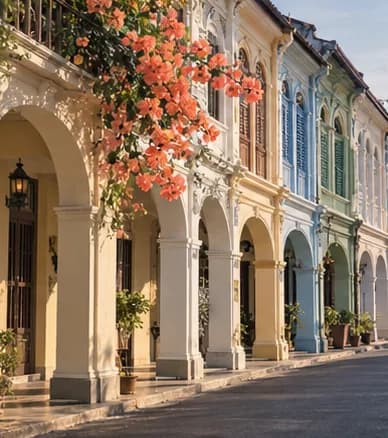
Many historic shophouses, buildings with a shop on the ground floor, are protected and can only be restored under special rules.