Questions?
We reply within 24 hours, free of charge.

Thailand's government appraised value is the official value the state sets for land, buildings and condominium units. The Land Office applies this value every time it registers a sale: the 2% transfer fee is always calculated from it, not from the price written in the contract. Other taxes on the sale — Specific Business Tax and stamp duty — are calculated from whichever is higher, the appraised value or the contract price; withholding tax follows the same rule for a company seller, but for an individual seller it is computed by the Land Office from the appraised value and the years of ownership. This guide explains who sets the appraised value, which payments are based on it, and what a new valuation cycle expected in 2027 may change.
In short
- A capital-appraisal committee sets the government appraised value within the official valuation system; the Land Office applies it when it registers a sale.
- The 2% transfer fee is always calculated from the appraised value, whatever price is in the contract.
- Specific Business Tax and stamp duty are calculated from whichever is higher — the appraised value or the contract price; a company seller's withholding tax follows the same rule, but an individual seller's withholding tax is based on the appraised value and the years of ownership.
- The annual Land and Building Tax is calculated from the appraised value too, with exemptions for an owner-occupied home.
- A new valuation cycle is expected to start on 1 January 2027, but the government has not confirmed it yet.
What the government appraised value is and who sets it
A capital-appraisal committee sets the government appraised value within the official Thai valuation system, covering land, buildings and condominium units. This figure is sometimes called the "assessed value," or, in everyday Russian, кадастровая стоимость — though the Thai system works differently from a cadastral register. The Land Office does not set this value; it applies the figure already set by the appraisal system when it registers a transfer of ownership and calculates the taxes based on it. A mortgage, a lease or another right over the property is registered on a different base — see the table below.
The appraised value is used for specified fees and taxes; it should not be treated as a market valuation of the property.
Which fees and taxes are based on it
| Payment | Base | Rate |
|---|---|---|
| Transfer fee | Appraised value | 2% |
| Specific Business Tax (if it applies) | Higher of appraised value or contract price | 3.3% |
| Stamp duty (only if SBT does not apply — never both) | Higher of appraised value or contract price | 0.5% |
| Withholding tax | Company seller: higher of the two values (1%). Individual seller: appraised value and years of ownership, computed by the Land Office | 1% (company); progressive (individual) |
| Mortgage registration | Loan amount secured | 1%, capped at THB 200,000 |
| Land and Building Tax (annual) | Appraised value | 0.02–0.10% for residential property |
Specific Business Tax applies when an individual sells within 5 years of acquiring the property, unless they have been registered in the house book there for a year or more, and whenever a company sells. Stamp duty applies instead when SBT does not — the two are never charged together.
The contract should state who pays each fee; if it is silent, the costs are shared equally. In resales the usual practice is to split the transfer fee, while the seller pays SBT or stamp duty and withholding tax. This does not change the tax obligations the law sets toward the state. We cover the full list of costs on a condo purchase in taxes and fees when buying a condo.
Want to know which fees apply to your purchase, and on which base? Send us the details and our lawyers will reply within 24 hours.
Assessed value vs contract price: which is used
Here's a typical example, with no connection to a real transaction. A condo has an appraised value of THB 4 million and sells for THB 5 million. The transfer fee is 2% of the appraised value: THB 80,000. Specific Business Tax, if it applies, is 3.3% of whichever figure is higher — here, the THB 5 million contract price — so THB 165,000.
Writing a lower price into the contract does not lower every fee's base. The transfer fee always follows the appraised value, so understating the price changes nothing there. For SBT and stamp duty, the base is the higher of the appraised value and the contract price; a company seller's withholding tax follows the same rule, while an individual seller's withholding tax is based on the appraised value and the years of ownership, not on the contract price. The contract should state the price actually paid — the figures above are only an illustration, not an official calculation.
How to look up your plot's or condo's value
To identify the exact plot or unit, check the original title deed and the registration record at the Land Office — not a photo, a copy or an agent's estimate. Once the property is identified, ask the Land Office for the current appraised value that applies to your transaction. We recommend doing this before you sign anything, not on the day of registration.
A short checklist before you sign:
- Ask the seller or developer for the unit's or plot's current appraised value.
- Confirm it against the original title deed and the Land Office's registration record — our lawyers can do this for you.
- Ask which figure — appraised value or contract price — each fee and tax in your deal will be based on.
- If you're buying a leasehold, confirm the registration fee is calculated from the rent, not the appraised value.
See also how to read a Thai land title deed before you rely on any figure tied to it.
A new valuation cycle: what may change
A new Treasury Department valuation cycle is reportedly expected to start on 1 January 2027. If appraised values rise, the base for the 2% transfer fee rises with them, and it can affect the Land and Building Tax bill too. The base for Specific Business Tax only rises where the new appraised value becomes higher than the sale price — if the sale price stays higher, SBT continues to be based on it. No official announcement has set a figure for how much values might change, and we have not found a government notice confirming the start date either. We will update this article once an official decision is published.
What changes, and what is not confirmed yet
We have not found an official notice confirming the 1 January 2027 start date for a new valuation cycle. Until one is available, check the current appraised value for your own property directly with the Land Office.
What's next
If you're about to buy or sell property on Phuket, the appraised value is the base the Land Office will use for the transfer fee; for SBT and stamp duty, the base is the higher of that value and the sale price. Our team can review your purchase or reservation contract and flag the fees and risks that apply to your deal — the review is free and takes up to 48 hours. We can also check the appraised value against the title deed and the registration record before you pay anything. For a full pre-purchase check, see checking a property before you pay.
Phuket areas
The same laws apply across the island, but each area has its own particulars: what kind of property usually sells there, which documents prove rights to the land and what deserves a closer look before you buy.

Kata
In sea-view condominiums the 49% foreign quota usually runs out quickly, so we check it before you reserve a unit.

Patong
People buy condos here to rent out and open businesses that need licences.

Kamala
There are many branded residences here, homes sold under a hotel brand, and the management agreement needs careful reading before you buy.
Old Town
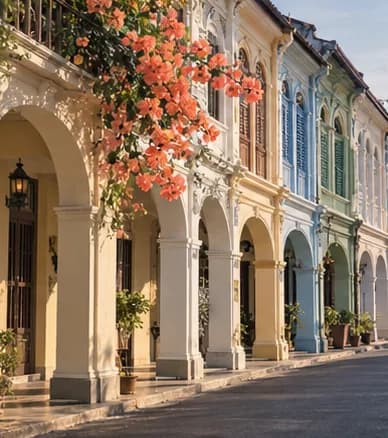
Many historic shophouses, buildings with a shop on the ground floor, are protected and can only be restored under special rules.