Questions?
We reply within 24 hours, free of charge.
Contents
- In short
- Who qualifies for a DTV?
- Where do I apply with a UK, US, Australian or EU passport?
- Which documents do you need?
- How much money do you need, and for how long?
- Why do DTV applications fail?
- What does a DTV cost, and how long does it take?
- What does a DTV not give you?
- What we could not confirm
- What next
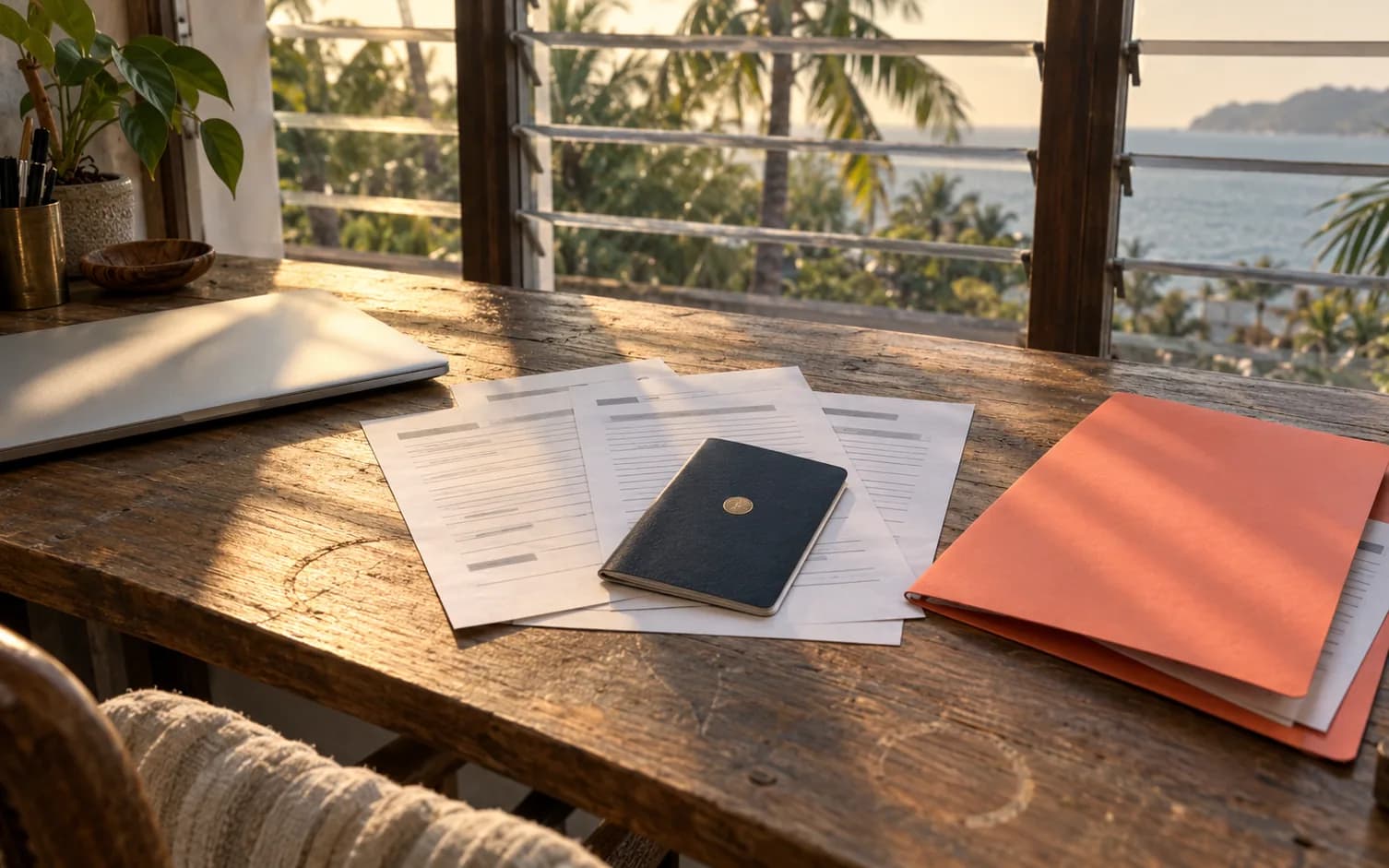
To get a Destination Thailand Visa (DTV) in 2026 you need a qualifying activity (remote work for foreign employers or clients, or a "soft power" activity such as Muay Thai or a cooking course), at least THB 500,000 in funds and a police certificate. Since 31 August 2026 you apply online through the e-visa system at the Thai mission of the country where you are a national or permanent resident. Rules are as of 6 October 2026.
In short
- A DTV lasts 5 years and allows up to 180 days per entry. You can extend once inside Thailand by 180 days for THB 1,900, but you cannot stay more than 360 days in a row (ThaiLawOnline, 5 October 2026).
- Since 31 August 2026 you apply only where you are a national or permanent resident. Posts in Vientiane, Savannakhet, Penang, Ho Chi Minh City and Jakarta now take only their own nationals and residents (ThaiLawOnline, 5 October 2026; visa advisers, September 2026).
- A police certificate is mandatory. London accepts one issued within six months, Washington and Los Angeles an FBI check issued within three months.
- You need THB 500,000 or the equivalent. At illustrative rates of THB 43 to the pound and THB 33 to the dollar, that is about GBP 11,600 or USD 15,000.
- The DTV does not allow work for Thai companies and gives no tax relief. In practice Thai banks often refuse DTV holders an account (Zagdim, 9 June 2026).
Who qualifies for a DTV?
You can apply from age 20 on one of two grounds: remote work for a foreign employer or foreign clients, or a soft power activity such as Muay Thai, a cooking course, sports training or medical treatment. A spouse and unmarried children under 20 apply as dependants, and each pays the full fee (ThaiLawOnline, 5 October 2026).
Remote work is shown by a contract with an employer outside Thailand or by client contracts, and freelancers add a portfolio. A soft power activity is shown by an enrolment or appointment letter that states the activity, dates, schedule and cost. Thai language courses were removed from the list, so use an ED visa for those (Thaiger, 26 August 2026).
Where do I apply with a UK, US, Australian or EU passport?
At the Thai mission that covers your country of nationality or permanent residence, through thaievisa.go.th. London asks for proof of permanent residence in the UK, Ireland or a British Overseas Territory, such as indefinite leave to remain. Washington takes a valid US visa or a green card (Royal Thai Embassy London, 8 September 2026; ThaiLawOnline, 5 October 2026).
Missions word the rule differently, because the Department of Consular Affairs issued the change on 28 August 2026 and each post published its own text between 1 and 12 September (Thaiger, about 15 September 2026). Los Angeles also accepts a US driving licence as proof of residence. Helsinki asks, among other things, for an accommodation booking of at least 7 days for the first visit (ThaiLawOnline, 5 October 2026). If you are Australian, Canadian or a citizen of an EU country, read the notice of the mission that covers you: we checked London and Washington in detail and a few other posts through secondary sources, not every post.
If you live in a third country on a temporary permit, you generally cannot file there any more (ThaiLawOnline, 5 October 2026). Applications submitted and paid before 31 August 2026 are decided under the old rules, and existing DTVs stay valid (ThaiLawOnline, 5 October 2026). If you are already in Thailand on the visa exemption, you cannot apply from inside the country: you leave and file at the right mission (Thaiger, 26 August 2026).
Which documents do you need?
The core file is a passport, a photo, statements showing at least THB 500,000, proof of your activity and a police certificate. Exact lists and formats differ by mission, so follow the notice of the post you will use (Royal Thai Embassy London, 8 September 2026; ThaiLawOnline, 5 October 2026).
| Document | What it is | What the mission checks |
|---|---|---|
| Passport and photo | Format and validity as the mission specifies | Match with the mission's checklist |
| Proof of funds | THB 500,000 or equivalent; statements from your home bank are accepted | Period and balance: Washington asks for three months, each ending at or above the threshold; London names no period |
| Activity: remote work | Contract with a foreign employer or contracts with foreign clients, portfolio | Employer and clients are outside Thailand |
| Activity: soft power | Enrolment or appointment letter, clinic letter for treatment | Activity, dates, schedule, cost |
| Police certificate | From your country of nationality or the country where you apply | Mandatory since 31 August 2026; London: ACRO or Irish certificate within six months; Washington and Los Angeles: FBI check within three months |
| Proof of residence | London: permanent residence such as ILR; Washington: valid US visa or green card | Match with the country where you file |
| Dependants | Marriage and birth certificates (to be legalised), names spelled identically | A name mismatch can cause a refusal that was avoidable |
How much money do you need, and for how long?
The threshold is THB 500,000 or the equivalent, which is about GBP 11,600 or USD 15,000 at the illustrative rates above (check the day's rate). ThaiLawOnline reports that London states its own sterling figure, GBP 12,000, so work to the mission's number rather than to the conversion. Missions set the statement period: Washington asks for three months of statements each ending at or above the threshold, and London names no period (ThaiLawOnline, 5 October 2026).
Thaiger (26 August 2026) says many posts now expect the balance to sit for about three months, and the money does not have to be in a Thai bank: statements from your home bank are accepted. Joint or sponsored accounts are accepted by some missions only, so ask first.
Why do DTV applications fail?
Thaiger (26 August 2026) calls a large deposit landed a week before filing a common reason for refusal, because the mission wants a balance held for months. Other sources add repeated causes, and nearly all of them come from preparation rather than from the activity itself (ThaiLawOnline, 5 October 2026):
- the statements cover a shorter period than the mission asks for;
- the application was filed from inside Thailand or at a third-country post;
- a Thai language course was presented as soft power, although it is off the list;
- a freelancer's file holds the words "I am a freelancer" but no contracts, invoices or portfolio;
- names differ across dependants' certificates.
After a refusal, start with the notice and compare its reason with your mission's checklist. A typical rebuild of a refused file is in the case study A DTV refused over a bank statement.
What does a DTV cost, and how long does it take?
The consular fee is THB 10,000, charged in local currency: GBP 300 in London, USD 400 in Washington and EUR 350 in Helsinki (ThaiLawOnline, 5 October 2026), and about NZD 2,000 in Wellington (Thaiger, 30 July 2026). Most posts decide within 5 to 15 working days, and the fee is not returned after a refusal (ThaiLawOnline, 5 October 2026).
The in-country extension of 180 days costs THB 1,900 at an immigration office. Ask the office in advance which documents it wants. After that you leave and re-enter, because the visa cannot cover more than 360 days in a row. It is not renewable after five years: you file a new application.
What does a DTV not give you?
A DTV does not allow work for Thai companies or Thai clients, gives no tax relief and does not guarantee a bank account. Inside Thailand you have three duties: a new TDAC for every entry, the 90-day report, and a TM30 that your landlord or host files. A DTV holder does not need a re-entry permit (ThaiLawOnline, 5 October 2026).
The TDAC is free and opens 72 hours before arrival, as the TDAC guide explains. The TM30 is due within 24 hours of your arrival, and the 90-day report is yours to file. Deadlines and fines are in TM30 and the 90-day report.
What we could not confirm
- How the "tourism only" wording of the visa exemption relates to remote work on a DTV. They are separate visas, but there is no official statement linking them.
- How London treats British citizens who live outside the UK, and which notices other missions, such as Canberra or Ottawa, have published.
- The statement period at London: the notice names none, while other posts expect about three months.
Date checked: 6 October 2026. If missions change their lists, we update this article.
What next
- Application support from a lawyer: DTV visa for Thailand.
- Other routes if a DTV does not fit: Thailand visa options in 2026 and Stay in Thailand longer than 30 days.
- A typical refusal and how the file was rebuilt: A DTV refused over a bank statement.
- Tax on income you bring in after 180 days: Tax on foreign income in Thailand in 2026.