Questions?
We reply within 24 hours, free of charge.
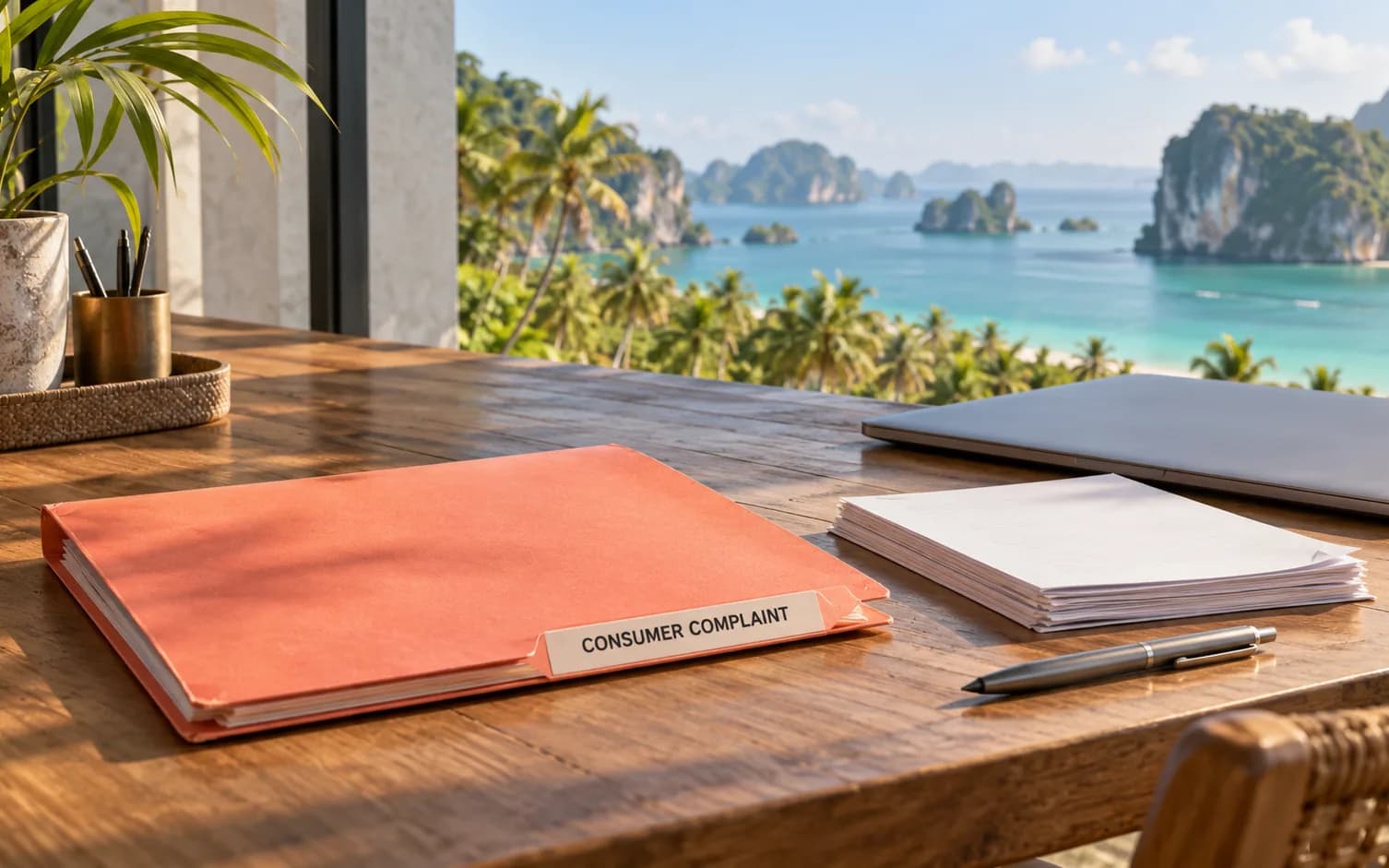
If a shop, developer or landlord in Thailand has broken your rights as a consumer, you can raise it with the Office of the Consumer Protection Board (OCPB): by phone on 1166, through ocpb.go.th, or in person, including at Damrongtham Centres, Thailand's one-stop government service points. Before you file, gather your contract or reservation form, receipts, correspondence and proof of payment. If the dispute does not settle, you can bring it as a consumer case: under the Consumer Case Procedure Act, a consumer is, as a rule, exempt from the court fee, though the Act sets exceptions, and you can even file the claim orally.
In short
- The OCPB is Thailand's consumer-protection body. Its Contract Committee can declare certain deals a "contract-controlled business" and force a standard form on them.
- Two rules matter most for buyers and renters: condo reservation sales (standard form since 31 January 2025) and residential leases from landlords with three or more units (since 4 September 2025).
- You can reach the OCPB by phone on 1166, online at ocpb.go.th, or in person; whether foreigners are covered and in what language is not officially confirmed yet.
- Before and after filing, collect your contract, receipts, correspondence and a written complaint to the seller — it strengthens your case everywhere.
- If the OCPB does not resolve things, the consumer court is usually fee-free, and a separate "Lemon Law" that would widen consumer rights is still only a bill, not in force.
What the OCPB handles
The OCPB takes and reviews complaints from consumers. For some kinds of contracts, its Contract Committee can go further and label the deal a "contract-controlled business": once that happens, the business must use a mandatory Thai-language form, and the notification lists clauses that count as unfair and are banned outright.
Two of these notifications matter most if you live on Phuket or are buying there. The first covers condominium unit sales by reservation, in force since 31 January 2025. The second covers residential leases from landlords who let three or more properties, in force since 4 September 2025. We go through both below, in the section on developers and landlords.
The OCPB also registers businesses that use direct marketing — a separate example of what falls under its remit, not something most readers will deal with directly. If you are not sure whether your situation fits the OCPB's mandate, it is worth asking the board itself; where you suspect fraud rather than a contract dispute, a police report is a separate, additional step, not a substitute.
How to file: online, hotline 1166, in person
You can reach the OCPB three ways: by calling the hotline on 1166, through the online form at ocpb.go.th, or in person, including at a Damrongtham Centre.
We recommend keeping every document from the deal and sending the seller or developer a written complaint first (a template follows in the next section). That letter helps fix what you are asking for and shows you tried to resolve it directly — useful whether you end up at the OCPB or in court.
What evidence to attach
Before you contact anyone, pull together whatever you have from this list. Exactly what a given channel asks for can vary, so having all of it ready saves a second trip:
- the contract or reservation form;
- receipts, invoices and bank proof of payment;
- correspondence with the seller or developer (email, messaging apps);
- photos of the defect or fault, if the dispute is about goods;
- the advertisement or listing page you relied on when you bought;
- your written complaint to the seller, and their reply — or proof that none came.
A short written complaint, followed by a reply or silence, is often the single most useful document in the file. Here is a short example — a condition example, not a legal template, so adapt it to your own facts:
"I ask that within 7 days of this letter you refund [amount] or fix [the defect] under the contract dated [date]. If I do not hear back, I will raise this with the Office of the Consumer Protection Board and, if needed, with the consumer court."
Say a British or American buyer paid a reservation deposit on a Phuket condo by bank transfer, and the developer then changed the unit's finish without agreement — the same letter works, just naming the reservation form and the deposit instead of a faulty product. We do not publish a Thai-language version of this template without a lawyer checking the wording first: phrasing that reads as firm in English can land very differently once translated.
Complaints about developers and property agents
If you reserved a condo unit, the developer is required to use the standard Thai reservation form: since 31 January 2025, selling condo units by reservation is a contract-controlled business under the OCPB Contract Committee's notification. The form bans a set of unfair clauses: the developer disclaiming liability for a late handover, keeping your reservation money when you were not in default, charging you to assign your reservation to someone else, and changing the terms unilaterally. Breaching these requirements can carry consequences, but we have not confirmed the exact rule or penalty — ask the OCPB directly if that detail matters to your case.
For buyers from the UK, the US or Australia, this is the point worth checking before you pay a second deposit instalment: compare your reservation paperwork against the standard form, and flag anything that departs from it. Our lawyers check exactly this as part of our free contract review.
On property agents: we have not found a specific Thai law requiring real-estate agents to hold a professional licence, but brokerage contracts themselves are governed by the Civil and Commercial Code. The absence of a licensing law does not mean an agent is automatically in the right. Build your complaint against an agency the same way you would against a seller — a written complaint first, then the OCPB or court if that does not work.
What happens after you file
We have not found an official timeline or procedure for how the OCPB handles a complaint once it is filed — that is a question worth putting to the board directly. While you wait, it helps to know about two routes that run alongside it.
A Thai court can appoint a mediator before a case is even filed, as long as the other side agrees — this comes from an amendment to the Civil Procedure Code. Separately, outside the court system, the Mediation Act of 2019 covers civil disputes, consumer disputes among them, and can end in a signed settlement if both sides agree to its terms. A mediator does not decide the case for you, and agreement is never guaranteed.
If the OCPB can't help: the consumer court
You can bring a claim against a seller or developer as a consumer case under the Consumer Case Procedure Act. A few features set it apart from an ordinary civil suit: as a rule, you are exempt from the court fee under section 18, though the Act carves out exceptions — for example, a claim brought in bad faith, demands that are clearly excessive, or deliberate delay. You can file the claim orally. The burden of proving facts known only to the seller or developer — why a defect happened, how something was made — sits with them, not you. And the limitation period on your claim is suspended while you are negotiating with the seller, under section 14.
| Where to go | When it fits | What you need | What we don't promise |
|---|---|---|---|
| OCPB | A contract breach, including under the standard condo-reservation or lease form | Contract, receipts, correspondence, written complaint | Timeline and outcome are not confirmed |
| Consumer court | The OCPB did not resolve it, or the issue needs a court ruling | Evidence of the dispute; the court sets its own filing requirements | The outcome and how long it takes |
| Mediation (court-appointed or under the 2019 Act) | Both sides are willing to talk | The other side's agreement to a mediator | A mediator proposes, never decides |
| Police | Signs of fraud, not just a broken contract; for online fraud and suspicious transfers, the AOC hotline is 1441 and technology-crime reports go through thaipoliceonline.go.th; for other matters, ask the police which channel applies | A report and proof of any money transferred | Police involvement does not get your money back automatically |
Our team will prepare the claim and the paperwork in two languages if your case ends up in court, and we will tell you plainly what your documents can actually prove, as opposed to what they merely suggest.
What to do next
If you are not sure whether to go to the OCPB, approach the developer directly, or head straight to court, start with a short consultation: our lawyers will look at your documents and set out the options. If your dispute involves a condo reservation or purchase, send us the contract — we review it free within 48 hours and flag the clauses worth raising with the developer before you sign anything further.
For ongoing support with property disputes and other legal matters on Phuket, you can reach a lawyer in Phuket: we answer within 24 hours and agree the cost before any work begins.